Joshua 10:11
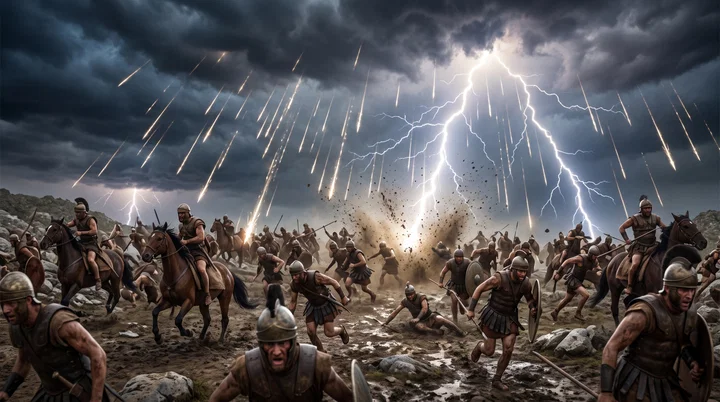
And it came to pass, as they fled from before Israel, and were in the going down to Beth-horon, that the LORD cast down great stones from heaven upon them unto Azekah, and they died: they were more which died with hailstones than they whom the children of Israel slew with the sword.
Translations
And it came to pass, as they fled from before Israel, and were in the going down to Bethhoron, that the LORD cast down great stones from heaven on them to Azekah, and they died: they were more which died with hailstones than they whom the children of Israel slew with the sword.
And it came to pass, as they fled from before Israel, and were in the going down to Beth-horon, that the LORD cast down great stones from heaven upon them unto Azekah, and they died: they were more which died with hailstones than they whom the children of Israel slew with the sword.
And it came to pass, as they fled from before Israel, and were in the going down to Beth-horon, that the Lord cast down great stones from heaven upon them unto Azekah, and they died: they were moe which died with hailstones than they whom the children of Israel slew with the sword.
And it came to pass as they fled from before Israel, and were in the descent to Beth-horon, that the LORD cast down great stones from heaven upon them to Azekah, and they died: they were more who died with hailstones than they whom the children of Israel slew with the sword.
And it came to pass, as they fled from before Israel, while they were in the going down of Beth-horon, that the LORD cast down great stones from heaven upon them unto Azekah, and they died: they were more which died with the hailstones than they whom the children of Israel slew with the sword.
And it came to pass, as they fled from before Israel, while they were at the descent of Beth-horon, that Jehovah cast down great stones from heaven upon them unto Azekah, and they died: they were more who died with the hailstones than they whom the children of Israel slew with the sword.
And it cometh to pass, in their fleeing from the face of Israel — they [are] in the descent of Beth-Horon — and Jehovah hath cast upon them great stones out of the heavens, unto Azekah, and they die; more are they who have died by the hailstones than they whom the sons of Israel have slain by the sword.
And it came to pass, as they fled from before Israel, — they were at the descent of Beth-horon, — that Jehovah cast down great stones from heaven upon them up to Azekah, and they died. They were more who died with the hailstones than they whom the children of Israel had slain with the sword.
And it came to pass, when they fled from before Israel, they, being on the slope of Beth-horon, that, Yahweh, cast down upon them great stones out of the heavens, as far as Azekah, and they died,—more, were they who died by the hailstones, than they whom the sons of Israel slew with the sword.
Berean Standard Bible, Majority Standard Bible
As they fled before Israel along the descent from Beth-horon to Azekah, the LORD cast down on them large hailstones from the sky, and more of them were killed by the hailstones than by the swords of the Israelites.
As they fled from before Israel, while they were at the descent of Beth Horon, the LORD hurled down great stones from the sky on them to Azekah, and they died. There were more who died from the hailstones than those whom the children of Israel killed with the sword.
And in their flight before Israel, on the way down from Beth-horon, the Lord sent down great stones from heaven on them all the way to Azekah, causing their death: those whose death was caused by the stones were more than those whom the children of Israel put to death with the sword.
And as they fled from before Israel, and were in the going downe to Beth-horon, the Lord cast downe great stones from heauen vpon them, vntill Azekah, and they dyed: they were more that dyed with the hailestones, then they whom the children of Israel slewe with the sword.
Douay-Rheims (Challoner revision)
And when they were fleeing from the children of Israel, and were in the descent of Beth-horon, the Lord cast down upon them great stones from heaven as far as Azeca: and many more were killed with the hailstones than were slain by the swords of the children of Israel.
Pictures

Cross-references
- Revelation 16:21
And there fell upon men a great hail out of heaven, every stone about the weight of a talent: and men blasphemed God because of the plague of the hail; for the plague thereof was exceeding great.
The great hail from heaven recalls the stones that struck the Amorites.
- Job 38:22-23
Hast thou entered into the treasures of the snow? or hast thou seen the treasures of the hail,
God reserves hail for a time of battle and war.
- Isaiah 28:21
For the LORD shall rise up as in mount Perazim, he shall be wroth as in the valley of Gibeon, that he may do his work, his strange work; and bring to pass his act, his strange act.
God’s judgment at Gibeon serves as a pattern of his strange work.
- Joshua 10:1-5
Now it came to pass, when Adoni-zedek king of Jerusalem had heard how Joshua had taken Ai, and had utterly destroyed it; as he had done to Jericho and her king, so he had done to Ai and her king; and how the inhabitants of Gibeon had made peace with Israel, and were among them;
Jerusalem’s king helps form the league against Joshua.
- Exodus 9:23-24
And Moses stretched forth his rod toward heaven: and the LORD sent thunder and hail, and the fire ran along upon the ground; and the LORD rained hail upon the land of Egypt.
The hail plague resembles the judgment by hailstones.
- Habakkuk 3:11-13
The sun and moon stood still in their habitation: at the light of thine arrows they went, and at the shining of thy glittering spear.
Recounts the Lord fighting in the same battle to save his people.
- Joshua 9
And it came to pass, when all the kings which were on this side Jordan, in the hills, and in the valleys, and in all the coasts of the great sea over against Lebanon, the Hittite, and the Amorite, the Canaanite, the Perizzite, the Hivite, and the Jebusite, heard thereof;
The cited account describes the Gibeonites’ deception and Israel’s treaty with them.
- Isaiah 30:30
And the LORD shall cause his glorious voice to be heard, and shall shew the lighting down of his arm, with the indignation of his anger, and with the flame of a devouring fire, with scattering, and tempest, and hailstones.
Both texts describe hailstones as an instrument of divine judgment.
Commentary
Each commentary is drawn from primary sources: the writings of Ellen G. White and Adventist pioneers and periodicals. Each commentary is separate. Its own words are not a quotation; follow the references to read the source passages.
Pioneers and periodicals
23 sources
At Gibeon the Lord fought for Israel against a league of five kings, and as they fled in the going down to Beth-horon unto Azekah He cast great stones from heaven upon them, so that more died by the hailstones than Israel slew with the sword.RH Apr 7, 1868ST Apr 8, 1897RH Jul 21, 1868 The victory was won because the Captain of Jehovah's hosts was with Israel, using the forces of nature to destroy His enemies and vindicate what is right.ST Mar 21, 1911ST Jul 31, 1893ST Jun 18, 1885 In casting the hailstones as the attackers fled, He kept faith with a people protected by an oath made in His name even though they had secured it by craft.RH May 26, 1868 The slaughter is a type of the battle of the great day and of the second advent, giving the pattern for the seventh vial when great hailstones will again be cast down from heaven upon men.RH Apr 12, 1870RH Jan 3, 1865ST Sep 4, 1879ST Aug 12, 1880 The souls destroyed in the conquest were the whole persons who were killed, showing that soul means a living person who can die, not an immortal being.ST Oct 3, 1906ST Mar 21, 1911ST Oct 9, 1907ST
Historical Setting and Details
The verse belongs to the battle at Gibeon, where Israel defeated a league of five kings that the king of Jerusalem had helped form.ST Apr 8, 1897RH Jul 21, 1868 As the enemy fled from before Israel in the going down to Beth-horon unto Azekah, the Lord cast great stones from heaven upon them.RH Apr 7, 1868 More died by the stones than the children of Israel slew with the sword.RH Apr 7, 1868 The stones may have been very large hailstones, meteoric stones, or both, but their fall was the Lord's own intervention to destroy the fleeing enemies.RH Apr 7, 1868
The day was lengthened so the work could be finished, yet it remained one day measured by the sun.ST Apr 8, 1897 Its unusual length did not change the order of the days or affect the seventh-day Sabbath.ST Apr 8, 1897 The verse belongs to the conquest of several petty kingdoms, in which sparing the peoples to continue their corrupt influence would have been a perversion of mercy.
Divine Power and Deliverance
The victory was won because the Captain of Jehovah's hosts was with Israel, with God's invisible army fighting for Israel as at Jericho.ST Mar 21, 1911 Trust in God brings victory, while failure to trust brings defeat as at Ai.ST Mar 21, 1911 Had Israel stayed faithful after such triumphs she would soon have possessed all the land, instead of falling into backsliding, captivity, and years of adversity when she might have lived in prosperity.ST Mar 21, 1911 The victory shows the practical, working faith of the generation that entered Canaan after crossing the Jordan, going out to war under the direction of the Lord of hosts, drilled in doing and daring in actual struggle and conflict for the King of kings.RH Apr 8, 1902 They were obedient as at Jericho and cleansed and toughened by discipline as at Ai.RH Apr 8, 1902 The victory at Beth-horon brought southern Canaan into subjection, as part of a war of several years against powerful opposed tribes and fenced cities until Canaan was mastered.RH Apr 8, 1902
God used the forces of nature to destroy Israel's enemies and vindicate what is right, and the hailstones killed more of the fleeing enemy than Israel's soldiers slew with the sword.ST Jul 31, 1893RH May 26, 1868ST Jun 18, 1885RH Jan 20, 1863RH Jan 6, 1859 Nature's laws are among God's means of delivering His people and fulfilling His promises.ST Jun 18, 1885 The hail from heaven striking the fleeing Canaanite armies was God's judgment with supernatural power that brought about their defeat.ST Jul 31, 1893RH Jan 20, 1863 It demonstrates God's power to bring judgment on proud enemies.RH Jan 6, 1859
The Lord fought for Gibeon after Israel had sworn to protect it, casting great hailstones upon the attackers as they fled toward Beth-horon, so that more died by the hailstones than by Israel's sword.RH May 26, 1868 This displays God's faithfulness to a people protected by an oath made in His name, despite their having secured it by craft.RH May 26, 1868
Final Judgment and Soul
The slaughter at Gibeon is a prophetic type of the battle of the great day, when hail will fall on the wicked, for the Lord fought for Israel by casting great hailstones from heaven on the fleeing enemies and more died by the hailstones than by Israel's swords.RH Apr 12, 1870 That same battle is a type of the great hailstones that fall under the seventh vial, when the Lord fights Israel's enemies by casting great stones from heaven.RH Jan 3, 1865 It is a literal judgment from heaven giving the pattern for the seventh vial of wrath, when great hailstones will again be cast down from heaven upon men, the beast and the false prophet will be taken, the remnant of men will be slain, and the earth will be desolated of its inhabitants.ST Sep 4, 1879 The Lord going forth to fight Israel's enemies in the day of battle by casting down great stones from heaven is a type of the second advent, when the Lord goes forth to fight against the nations gathered against Jerusalem, fulfilled in the great hailstones under the seventh vial in the battle described in symbol in Revelation 19.ST Aug 12, 1880
The destruction with supernatural power, when great hailstones fell on the fleeing enemies and more died from the hailstones than from the swords, is a precedent for the final judgment, when Christ comes forth from the heavenly sanctuary and the wicked perish under God's punishment.ST Jul 31, 1893 It is a precedent for the final outpouring of wrath, when hail will fall in the last plague near Beth-horon and the wicked will perish as Christ's restrained wrath is released, killing more than Israel killed with the sword.ST Sep 6, 1899 The stones hurled upon the fleeing Amorite armies going down toward Beth-horon and Azekah, killing more than the sword, serve as a precedent for a future heavenly-stones catastrophe described as even more dreadful.RH May 16, 1871
The people called souls in the conquered towns were destroyed when killed, showing that soul refers to a person who can die, not an immortal being.ST Oct 3, 1906 Souls destroyed in the wars means the whole persons who were killed, the people themselves in the cities, whom Joshua destroyed.ST Mar 21, 1911ST Jun 21, 1905ST Dec 27, 1905 Soul can mean a person or living creature, as people slain in the account are called souls, with the original wording meaning dead soul.ST May 15, 1907 Soul means the entire man, the person himself, so slaying all the souls in the cities means killing all the persons there, the same meaning as man became a living soul meaning a living person, a term also used of the lowest creatures that have animal life.ST Oct 9, 1907 The repeated use of soul for persons over and over shows its primary meaning is the whole being, the whole creature, a living person.ST
Sources