Judges 12:6
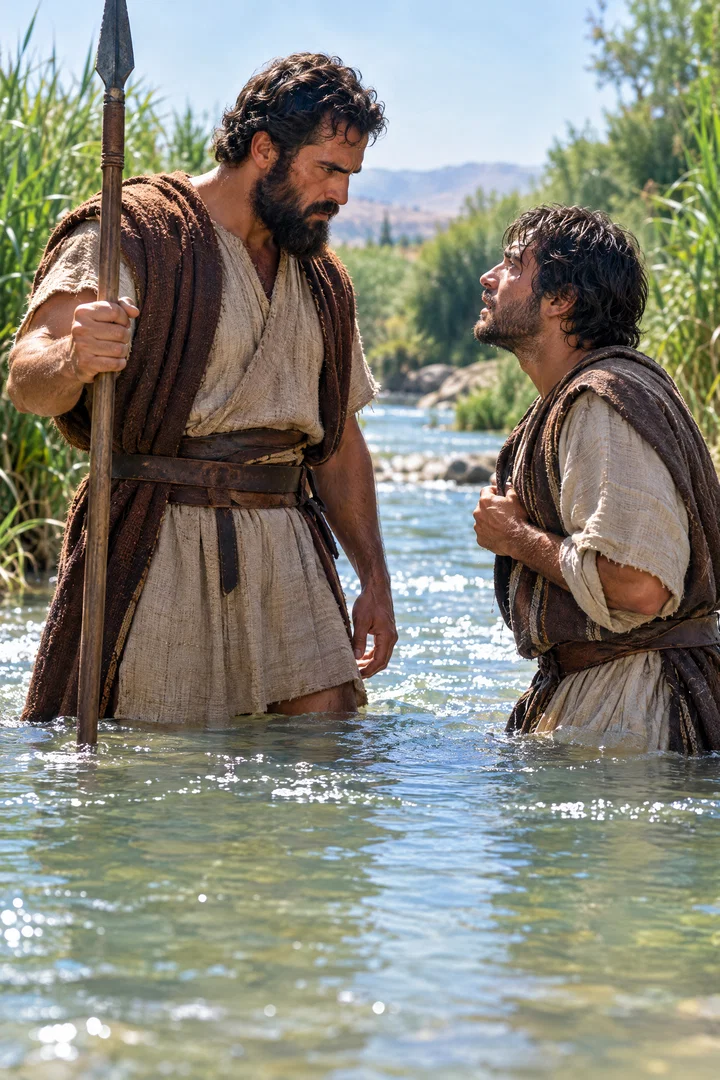
Then said they unto him, Say now Shibboleth: and he said Sibboleth: for he could not frame to pronounce it right. Then they took him, and slew him at the passages of Jordan: and there fell at that time of the Ephraimites forty and two thousand.
Translations
Then said they to him, Say now Shibboleth: and he said Sibboleth: for he could not frame to pronounce it right. Then they took him, and slew him at the passages of Jordan: and there fell at that time of the Ephraimites forty and two thousand.
Then said they unto him, Say now Shibboleth: and he said Sibboleth: for he could not frame to pronounce it right. Then they took him, and slew him at the passages of Jordan: and there fell at that time of the Ephraimites forty and two thousand.
then said they unto him, Say now Shibboleth: and he said Sibboleth: for he could not frame to pronounce it right. Then they took him, and slew him at the passages of Jordan: and there fell at that time of the Ephraimites forty and two thousand.
Then said they to him, Say now Shibboleth: and he said Sibboleth: for he could not frame to pronounce it right. Then they took him, and slew him at the passages of Jordan. And there fell at that time of the Ephraimites forty and two thousand.
then said they unto him, Say now Shibboleth; and he said Sibboleth; for he could not frame to pronounce it right; then they laid hold on him, and slew him at the fords of Jordan: and there fell at that time of Ephraim forty and two thousand.
then said they unto him, Say now Shibboleth; and he said Sibboleth; for he could not frame to pronounce it right: then they laid hold on him, and slew him at the fords of the Jordan. And there fell at that time of Ephraim forty and two thousand.
that they say to him, 'Say, I pray thee, Shibboleth;' and he saith, 'Sibboleth,' and is not prepared to speak right — and they seize him, and slaughter him at the passages of the Jordan, and there fall at that time, of Ephraim, forty and two chiefs.
Then they said to him, Say now Shibboleth! and he said, Sibboleth, and did not manage to pronounce [ it] rightly. Then they took him, and slaughtered him at the fords of the Jordan. And there fell at that time of Ephraim forty-two thousand.
they said to him, Come now, say Shibboleth, and, if he said Sibboleth, and he could not take heed to speak in that manner, then laid they hold on him, and slew him at the fords of the Jordan,—and there fell, at that time, of the Ephraimites, forty-two thousand.
Berean Standard Bible, Majority Standard Bible
they told him, “ Please say Shibboleth.”If he said, “ Sibboleth,” because he could not pronounce it correctly, they seized him and killed him at the fords of the Jordan. So at that time 42,000 Ephraimites were killed.
then they said to him, “ Now say ‘ Shibboleth;’” and he said “ Sibboleth”; for he couldn’t manage to pronounce it correctly, then they seized him and killed him at the fords of the Jordan. At that time, forty-two thousand of Ephraim fell.
Then they said to him, Now say Shibboleth; and he said Sibboleth, and was not able to say it in the right way; then they took him and put him to death at the crossing-places of Jordan; and at that time forty-two thousand Ephraimites were put to death.
Then said they vnto him, Say nowe Shibboleth: and he said, Sibboleth: for he could not so pronounce: then they tooke him, and slewe him at the passages of Iorden: and there fel at that time of the Ephraimites two and fourtie thousand.
Douay-Rheims (Challoner revision)
They asked him: Say then, Scibboleth, which is interpreted, An ear of corn. But he answered, Sibboleth, not being able to express an ear of corn by the same letter. Then presently they took him and killed him in the very passage of the Jordan. And there fell at that time of Ephraim two and forty thousand.
Pictures
Cross-references
- Matthew 26:73
And after a while came unto him they that stood by, and said to Peter, Surely thou also art one of them; for thy speech bewrayeth thee.
Peter’s speech disclosed that he was a Galilean.
Commentary
Each commentary is drawn from primary sources: the writings of Ellen G. White and Adventist pioneers and periodicals. Each commentary is separate. Its own words are not a quotation; follow the references to read the source passages.
Ellen G. White
1 source
The Shibboleth is a plain test that marks out a clearly defined position on God's side.Lt 44, 1903, par. 42 To give that plain Shibboleth is to stand without wavering on the platform of truth.Lt 44, 1903, par. 42 It is to hold the banner of truth firmly aloft, so that no one can fail to see on which side one stands.Lt 44, 1903, par. 42
Giving it requires a pure and holy heart, free from pretense and deception.Lt 44, 1903, par. 42 It requires knowing the meaning of godly ministry, discerning between righteousness and unrighteousness and between truth and error, and serving God with all the powers of body, mind, and soul as a faithful sentinel standing firm for the right in time of peril.Lt 44, 1903, par. 42 Those who cannot give it are halfhearted and halfconverted, whose reasoning leads minds into confusion despite great light and many opportunities, and God cannot accept them whatever their profession may be.Lt 44, 1903, par. 42
Sources
Pioneers and periodicals
15 sources
The Gileadites held the crossings of the Jordan to prove nationality and cut off escaping Ephraimites who failed the test.RH Jul 15, 1873RH Dec 30, 1873RH Mar 11, 1858 A true Gileadite could sound the opening sh correctly, while an Ephraimite could not frame it rightly but said s instead, and forty-two thousand fell at that time for that failure.RH Dec 30, 1873ST Aug 19, 1886RH Dec 30, 1873ST Aug 19, 1886 Their speech betrayed them when outward appearance could not distinguish them.ST Aug 19, 1886ST Aug 19, 1886 So a person's speech and life reveal which spiritual community he belongs to, for the citizen of heaven speaks from heavenly interests and spiritual experience while one alienated from God cannot truly speak the language of Canaan.RH Mar 11, 1858RH Jul 15, 1873 The law and precepts of God are that spiritual Shibboleth, the mark of loyalty and strength and deliverance, where even a seemingly one-letter failure leaves a person accountable for the whole.RH Jul 15, 1873RH Jul 15, 1873
Words and Historical Setting
The verse stands among the closing histories of Judges in a fearfully checkered time in Israel's history, coming after Jephthah's victory over the Ammonites and before the judgeship of Samson.ST Mar 24, 1909 It belongs to the troubled period under unsatisfactory judges, marked by backsliding from God bringing suffering, oppression, captivity and servitude and subjection to heathen peoples with loss of the land's prosperity, followed after delayed repentance by return to God with forgiveness and only partial deliverance through mercy and restoration.ST Apr 4, 1911ST
The Gileadites held the passages of Jordan and tested men wanting to cross in order to prove nationality and identify escaping Ephraimites, and those who failed the test were recognized by their speech and killed at the crossings.RH Jul 15, 1873RH Dec 30, 1873RH Mar 11, 1858ST Aug 19, 1886RH Jul 15, 1873 The same test is described as turning on the word used to identify Ephraimites by pronunciation, applied figuratively to immersion as a distinctive belief compromised by pronouncing it weakly rather than upholding it firmly.ST Sep 9, 1889 Shibboleth marked a Gileadite, while Sibboleth marked an Ephraimite who could not frame to pronounce it right but said s instead of sh, especially failing the initial sound.RH Dec 30, 1873ST Aug 19, 1886RH Dec 30, 1873RH Jul 15, 1873 Their speech disclosed their identity when outward appearance could not distinguish them.ST Aug 19, 1886ST Aug 19, 1886
Forty and two thousand Ephraimites fell at that time at the Jordan crossings for inability to pronounce Shibboleth, saying Sibboleth instead.ST Aug 19, 1886 The word means ear of grain, and Sibboleth may have had the same meaning in the Ephraimite dialect, while its root also means burden, but the test concerned pronunciation and not the word's meaning.RH Jul 15, 1873 The distinction rested on descent, with Gilead as the grandson of Manasseh, and Manasseh as the elder son of Joseph and Ephraim as the younger son.RH Dec 30, 1873
The speech of Joseph's family in Egypt was old Egyptian, the root of Coptic, and Coptic is cognate to Greek as Chaldaic is to Hebrew, so the speech of Egypt at that time was similar to old Greek, which accounts for Ephraim losing sh while Manasseh's line retained it.RH Dec 30, 1873 Those who held this explanation taught that the Ephraimites said Sibboleth because they had lost the sh sound while Manasseh retained it, the Greek letter sampi answering to English sh and having fallen into disuse so that the sound of sh was lost, the loss occurring between the childhood of Manasseh and the childhood of Ephraim, still in use for the elder son and out of use for the younger.RH Dec 30, 1873
Spiritual Tests and Applications
The Jordan crossing shows how a distinction between peoples could be put to a decisive test, and that testing belongs with the calling of God's chosen people to obedience, to prove whether they would keep His commandments.RH Jul 15, 1873 Speech betrays belonging when outward appearance cannot, for a citizen of heaven speaks out of heavenly interests and spiritual experience, while one alienated from God cannot truly speak that language.RH Jul 15, 1873 Those who cannot speak the language of Canaan are therefore not admitted to the heavenly places but are turned away.RH Mar 11, 1858RH Jul 15, 1873
The law and precepts of God are the spiritual Shibboleth, the mark of loyalty and the source of strength and deliverance from enemies.RH Jul 15, 1873 The difference of a single letter shows that a seemingly small failure in keeping the law makes a person accountable for the whole law.RH Jul 15, 1873 Faith and works belong together and salvation cannot be separated from both, with Christ as the essential element in the law of righteousness.RH Jul 15, 1873 The test also pictures the final choice between loyalty to God and the opposing power, in which those who do not accept the warning and live by God's commandments and the faith of Jesus will face destruction.RH Jul 15, 1873
The word is used figuratively for immersion as a distinctive belief, which some through compromise pronounce as Sibboleth rather than uphold firmly.ST Sep 9, 1889 The Sunday cause is called a political shibboleth professed to win religious votes, contrasting those who conform outwardly to avoid persecution with those who remain faithful to conscience.ST Jan 9, 1893 The verse supplies the image of a shibboleth as a word used to distinguish people by correct pronunciation and as a distinctive password peculiar to a group, as when each Santal sept is said to have its own shibboleth.RH Oct 6, 1904 It also serves as an example of making people offenders over a trivial difference in pronouncing a word, used to identify and condemn them.ST May 20, 1908
Sources