Translations
American King James Version, Webster Bible
And the LORD spoke to Moses, saying,
King James Version, Revised Version
And the LORD spake unto Moses, saying,
And the Lord spake unto Moses, saying,
And Jehovah spake unto Moses, saying,
And Jehovah speaketh unto Moses, saying,
And Jehovah spoke to Moses, saying,
And Yahweh spake unto Moses, saying:
Berean Standard Bible, Majority Standard Bible
Then the LORD said to Moses,
The LORD spoke to Moses, saying,
And the Lord said to Moses,
And the Lord spake vnto Moses, saying,
Douay-Rheims (Challoner revision)
And the Lord spoke to Moses, saying:
Pictures
Commentary
Each commentary is drawn from primary sources: the writings of Ellen G. White and Adventist pioneers and periodicals. Each commentary is separate. Its own words are not a quotation; follow the references to read the source passages.
Pioneers and periodicals
5 sources
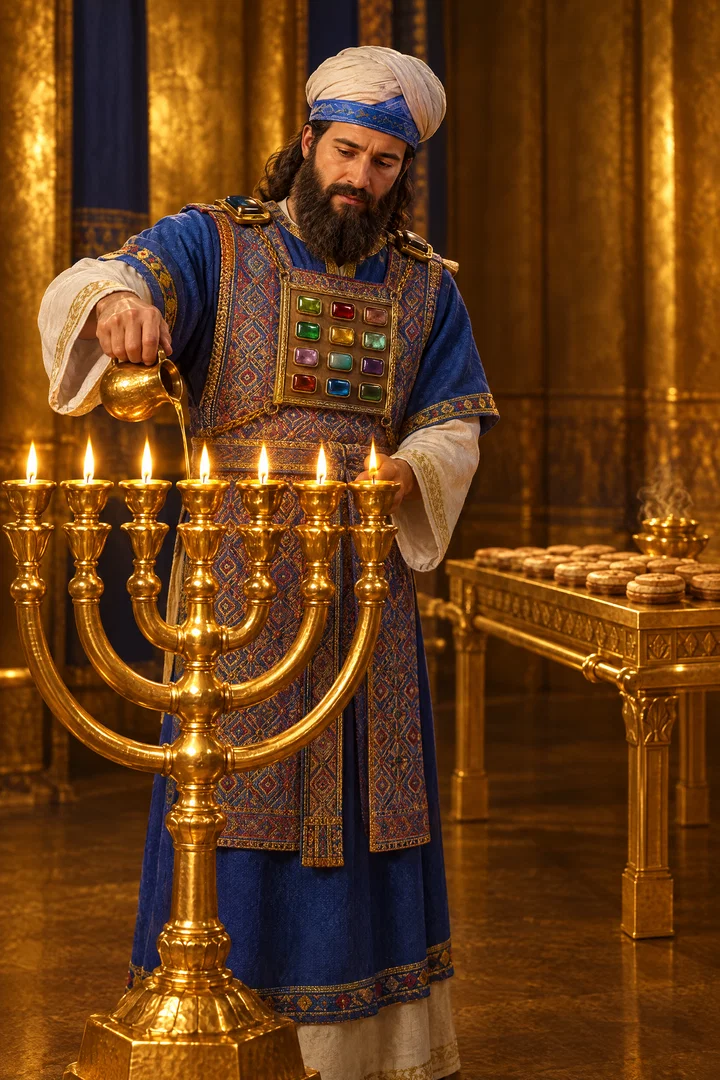
Leviticus 24:1 opens the Lord's directions to Moses regarding the continual sanctuary lamps and the bread of God's presence.ST Apr 29, 1897ST Feb 14, 1911 The lamps were to be supplied with pure olive oil so that they would burn continually.ST Apr 29, 1897ST May 8, 1901 The priests were to trim and refill them each morning and evening so the light would not go out, with Aaron and his sons tending them from evening until morning before the Lord.ST Apr 29, 1897ST May 8, 1901 Because the tabernacle had no windows, the lamps were never all extinguished at once but gave light by day and night.ST May 8, 1901
The ceremonial precept beginning here, commanding the setting forth of the showbread on the Sabbath, was given some time after Moses set up the tabernacle and placed the table and the showbread in it on the first day of the first month.ST Jul 17, 1879 Because that command did not yet exist when the tabernacle was set up, it furnishes no proof that that first day was the weekly Sabbath.ST Jul 17, 1879 Although the lamp command beginning here calls for the lamps to burn continually as a statute forever, forever and perpetual there do not mean unending duration.RH Jun 10, 1862 They mean only the utmost duration the person or thing allows, determined by its nature rather than by the words themselves.RH Jun 10, 1862
Applied to the lamp service and to the passover, priesthood, trumpets, incense, sacrifices, and other Jewish institutions, forever means limited duration, because they originated with the Jewish nation as types and shadows pointing to Christ and their duration was fully accomplished when the substance was reached.RH Jun 10, 1862 Applied to the seventh-day Sabbath, forever means unceasing continuance, because the Sabbath is not a type, was made at creation before sin entered and before types were necessary, and is a memorial ever pointing backward to the fact that in six days the Lord made heaven and earth and rested the seventh day.RH Jun 10, 1862 The Sabbath was made for man and is universal to all men and nations, rests on the same necessity and reasons today as thousands of years ago, and belongs to a law as eternal as God.RH Jun 10, 1862 The tending of the lamps illustrates Christ removing what hinders His people from shining and giving them more of the Holy Spirit, represented by the oil.ST May 8, 1901
Sources