Mark 3:23
And he called them unto him, and said unto them in parables, How can Satan cast out Satan?
Translations
American King James Version, Webster Bible
And he called them to him, and said to them in parables, How can Satan cast out Satan?
King James Version, KJV Cambridge Paragraph Bible, Revised Version, American Standard Version
And he called them unto him, and said unto them in parables, How can Satan cast out Satan?
And, having called them near, in similes he said to them, 'How is the Adversary able to cast out the Adversary?
And having called them to [ him], he said to them in parables, How can Satan cast out Satan?
And, calling them near, in parables, began he to say unto them—How can, Satan, cast, Satan out?
Berean Standard Bible, Majority Standard Bible
So Jesus called them together and began to speak to them in parables: “ How can Satan drive out Satan?
He summoned them and said to them in parables, “ How can Satan cast out Satan?
And turning to them, he said to them in the form of a story, How is it possible for Satan to put out Satan?
But he called them vnto him, and said vnto them in parables, How can Satan driue out Satan?
Douay-Rheims (Challoner revision)
And after he had called them together, he said to them in parables: How can Satan cast out Satan?
Pictures
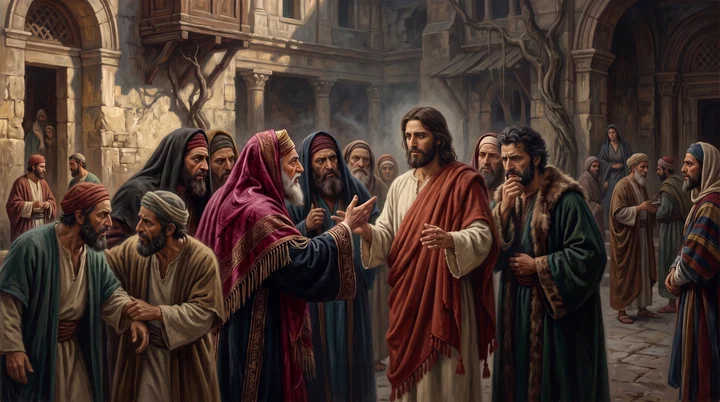
Cross-references
- Matthew 12:25-26
And Jesus knew their thoughts, and said unto them, Every kingdom divided against itself is brought to desolation; and every city or house divided against itself shall not stand:
Parallel account of Jesus’ argument that Satan does not cast out Satan.
- Luke 11:17-18
But he, knowing their thoughts, said unto them, Every kingdom divided against itself is brought to desolation; and a house divided against a house falleth.
The parallel account gives the same argument about Satan’s kingdom.
- Matthew 9:34
But the Pharisees said, He casteth out devils through the prince of the devils.
Records the same charge Jesus answers.
- Mark 3:27
No man can enter into a strong man’s house, and spoil his goods, except he will first bind the strong man; and then he will spoil his house.
Jesus describes binding the strong man and taking his possessions.
- Matthew 12:28
But if I cast out devils by the Spirit of God, then the kingdom of God is come unto you.
Jesus says demons are cast out by God’s Spirit.
- Matthew 12:22
Then was brought unto him one possessed with a devil, blind, and dumb: and he healed him, insomuch that the blind and dumb both spake and saw.
identifies the healing of the blind and dumb possessed man
- Matthew 12:31-32
Wherefore I say unto you, All manner of sin and blasphemy shall be forgiven unto men: but the blasphemy against the Holy Ghost shall not be forgiven unto men.
Warns against attributing the Holy Spirit’s work to Satan.
- Mark 3:28-29
Verily I say unto you, All sins shall be forgiven unto the sons of men, and blasphemies wherewith soever they shall blaspheme:
Explains the unforgivable sin linked to the accusation against Jesus.
Commentary
Each commentary is drawn from primary sources: the writings of Ellen G. White and Adventist pioneers and periodicals. Each commentary is separate. Its own words are not a quotation; follow the references to read the source passages.
Ellen G. White
4 sources
The question was asked just after Jesus for the second time healed a demon-possessed man who was both blind and dumb, when the Pharisees repeated the charge that He cast out devils by the prince of devils.DA 321.3 It belongs to the same reply to that charge of casting out demons by the prince of demons that is stated in Matthew 9:34 and told at length in Matthew 12:22-50, on the same occasion that raises the question of who His brethren are.DA 321 The charge came while He spent whole nights in prayer and His days were crowded by large multitudes, laboring incessantly without even time to eat.DA 321.1–2 His friends thought He was wearing Himself out and could not account for His attitude toward the Pharisees, and some feared His reason was becoming unsettled and His mind was failing.DA 321.1–2
At the same time His brothers, stung by the reproach brought upon them through relation to Him, disturbed by the tumult His words and works created, alarmed by His bold statements and indignant at His denunciation of the scribes and Pharisees, decided He must be persuaded or constrained to stop this manner of labor.DA 321.1–2 They enlisted Mary to join them, in hopes that His love for her would make Him more prudent and they might prevail upon Him to be more prudent.DA 321.1–2 In the verse He answers the accusation that His works came from Satan by exposing its self-contradiction, that Satan does not cast out Satan.4MR 360.1
Unable to deny His works or explain them naturally, His accusers attributed God's holy power to the devil, and this deliberate rejection of clear evidence was sin against the Holy Spirit that led to the unpardonable sin.4MR 360.1 To attribute the work of the Holy Spirit to Satan cuts the person off from the fountain of blessing, because by wilfully declaring the Spirit's work to be from Satan men cut off the channel by which God can communicate with them.DA 321.3 Speaking against Jesus Himself without discerning His divine character can be forgiven, because through the Spirit the person can still be brought to see the error and repent, and whatever the sin, if the soul repents and believes its guilt is washed away in the blood of Christ.DA 321.3 But the one who rejects the work of the Holy Spirit places himself where repentance and faith cannot come to him, since it is by the Spirit that God works upon the heart, so that when the Spirit is finally rejected there is nothing more God can do for the soul.DA 321.3
Sources
Pioneers and periodicals
13 sources
When certain Jews charged that Jesus drove out demons by Beelzebub rather than by God, though He worked by the Spirit, He called them to face Him publicly before the crowd and answered in parables by asking how Satan could drive out Satan.RH Oct 30, 1860ST Nov 12, 1894ST Sep 4, 1907ST Jan 10, 1878 The question exposes the charge as foolish and self-contradictory, for Satan will not oppose himself, since a kingdom divided against itself falls into ruin and comes to an end.RH Oct 30, 1860ST Nov 12, 1894ST Aug 6, 1912RH Jun 25, 1867ST Aug 11, 1914 His kingdom is not divided against itself but is united in opposition to God's kingdom, and the demons Jesus expelled belong to Satan's company of evil spirits.RH Jun 25, 1867RH Jul 10, 1856 To credit the Spirit's work to satanic agency is blasphemy against the Holy Ghost, for which there is no forgiveness, not because God lacks mercy but because it rejects the only power that removes sin and the means by which God saves.ST Oct 6, 1909ST Aug 6, 1912ST Jan 10, 1878ST Aug 11, 1914 That sin is not one isolated act but persistent refusal to repent until the heart is hardened and closed to divine influence, while rejection in ignorance may be forgiven and concern for one's standing shows it has not been committed.ST Jul 8, 1930ST Aug 11, 1914
Context and Meaning
The saying belongs to the moment when certain Jews charged that Jesus drove out demons not by God but by Beelzebub, the prince of demons, although those miracles were wrought by the Spirit through Jesus.ST Nov 12, 1894ST Sep 4, 1907ST Jan 10, 1878 He called his accusers to face him publicly before the crowd and answered them in parables by asking how Satan could cast out Satan.RH Oct 30, 1860 The question lays bare the charge as foolish and self-contradictory, because it makes Satan out to be opposing himself.ST Aug 6, 1912RH Jun 25, 1867ST Aug 11, 1914
Satan would not cast out Satan, since to work against himself would divide his kingdom against itself and bring it to ruin and an end.RH Oct 30, 1860ST Nov 12, 1894ST May 17, 1899 He is not divided against himself, and though his kingdom may contain internal discord, it stands united in opposition to God's kingdom and could not stand if divided against itself.RH Jul 10, 1856 The demons Jesus expelled were of Satan's company, that is, evil spirits or fallen angels.RH Jun 25, 1867
Blasphemy Against the Spirit
Jesus cast out demons by the Spirit of God, and the charge that He did so by Beelzebub attributed the Holy Spirit's work to satanic agency and to an evil spirit.ST Oct 6, 1909ST Aug 6, 1912ST Jan 10, 1878 The accusation treated the work of God's Spirit as the work of the devil while exposing its own contradiction in making Satan cast out Satan.ST Oct 6, 1909ST Aug 6, 1912
It was made despite clear evidence of God's power and compassion displayed in the deliverance of the afflicted.ST Aug 6, 1912 The miracles were wrought by that same Spirit and agreed with the Scriptures held by the Jews, yet they were called the devil's work.ST Aug 6, 1912ST Aug 11, 1914
To attribute the Spirit's work to Satan in this way is blasphemy against the Holy Ghost, the sin for which there is no forgiveness.ST Oct 6, 1909ST Jan 10, 1878ST Aug 11, 1914 It is unpardonable not because God lacks mercy, but because it rejects the only power that can remove sin and rejects the means God uses to save people.ST Oct 6, 1909ST Aug 11, 1914
That unpardonable sin is not a single isolated act but the culmination of persistently rejecting the invitation to repent until the heart is hardened against God and no longer receives divine influence.ST Jul 8, 1930ST Aug 11, 1914 The hostile response to Jesus illustrates this willful resistance, and persistent rejection of the Spirit's work cuts the person off from that means and leads to eternal sin.ST Jul 8, 1930ST Aug 11, 1914
There is no forgiveness because the person has closed the way back to God by refusing the influence that could lead to repentance.ST Jul 8, 1930 Rejection done in ignorance may be forgiven, and concern about one's standing with God is evidence that this sin has not been committed.ST Jul 8, 1930ST Aug 11, 1914
Wider Applications of Principle
Satan does not work against his own cause by turning his own followers against one another.RH Jan 15, 1857 When violent mobs are stirred up against Adventists who offer no resistance, that violence cannot be the spirit or work of Christ.RH Jan 15, 1857 To say otherwise would make Satan to be opposing Satan.RH Jan 15, 1857
The fact that Satan does not oppose and drive out himself does not prove a doctrine false merely because spiritualism teaches it.RH Jul 10, 1856 Satan is not divided against himself, yet the satanic source claimed for spiritualism does not by itself settle the truth of what spiritualists teach.RH Jul 10, 1856 The doctrine that the dead are unconscious is not shown to be satanic on that ground.RH Jul 10, 1856
Satan does not cast out Satan, for evil is not driven out by more evil.RH Jun 26, 1860 In conflict between people, bitterness and harshness cannot dispel bitterness.RH Jun 26, 1860 Meekness and sweetness can overcome it, and such overcoming is God's work.RH Jun 26, 1860
Sources