Translations
American King James Version, Webster Bible
And the LORD spoke to Moses, saying,
King James Version, Revised Version
And the LORD spake unto Moses, saying,
And the Lord spake unto Moses, saying,
And Jehovah spake unto Moses, saying,
And Jehovah speaketh unto Moses, saying,
And Jehovah spoke to Moses, saying,
Then spake Yahweh unto Moses, saying—
Berean Standard Bible, Majority Standard Bible
Then the LORD said to Moses,
The LORD spoke to Moses, saying,
And the Lord said to Moses,
Then the Lord spake vnto Moses, saying,
Douay-Rheims (Challoner revision)
And the Lord spoke to Moses, saying:
Pictures
Cross-references
- Exodus 32:26-29
Then Moses stood in the gate of the camp, and said, Who is on the LORD’s side? let him come unto me. And all the sons of Levi gathered themselves together unto him.
The Levites’ faithfulness in the golden-calf crisis is given as the reason for their honor.
- Exodus 40:15
And thou shalt anoint them, as thou didst anoint their father, that they may minister unto me in the priest’s office: for their anointing shall surely be an everlasting priesthood throughout their generations.
Cited with Numbers 3 for the priesthood established for that age.
- Numbers 8:19
And I have given the Levites as a gift to Aaron and to his sons from among the children of Israel, to do the service of the children of Israel in the tabernacle of the congregation, and to make an atonement for the children of Israel: that there be no plague among the children of Israel, when the children of Israel come nigh unto the sanctuary.
The Levites serve at the sanctuary and protect Israel from plague.
Commentary
Each commentary is drawn from primary sources: the writings of Ellen G. White and Adventist pioneers and periodicals. Each commentary is separate. Its own words are not a quotation; follow the references to read the source passages.
Ellen G. White
3 sources
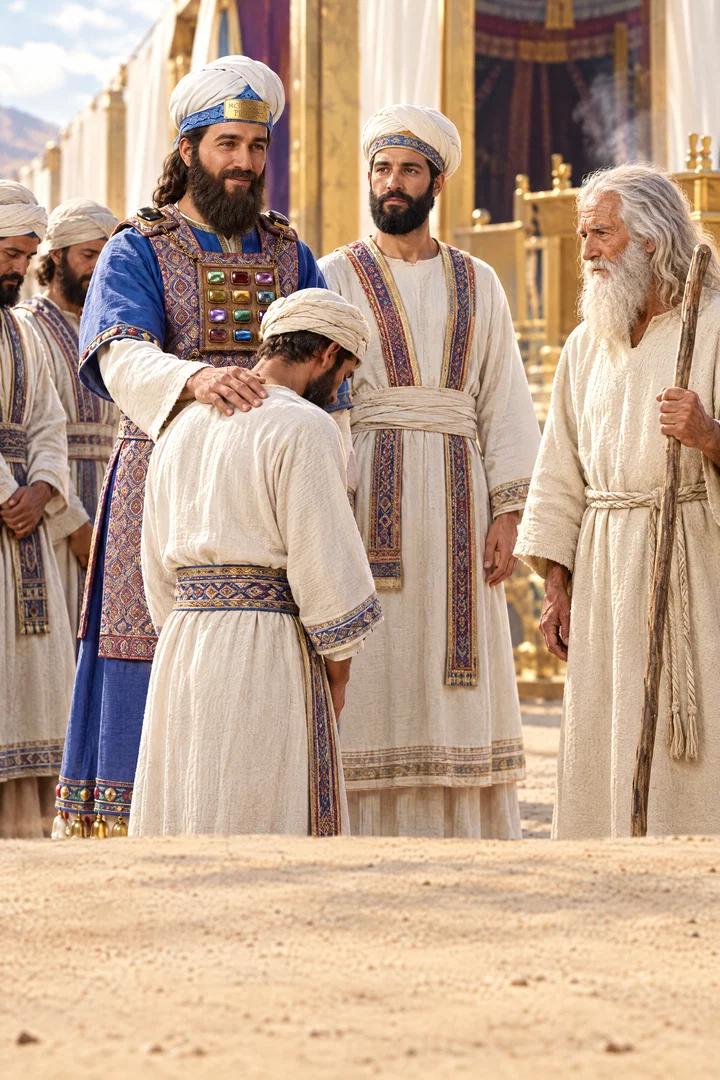
The Lord speaking to Moses here begins His directions appointing the Levites to sacred service at the tabernacle.1T 650.2–652.1SG4 28.1–2 They were honored with this appointment because they refused to join in worship of the golden calf and executed His command against the idolaters.SG4 28.1–2 Their assigned work was to erect the tabernacle, encamp around it, and take it down and carry it with the ark and its sacred furnishings when Israel journeyed, with particular families appointed to the carrying.1T 650.2–652.1SG4 28.1–2
This appointment for tabernacle service was distinct from the priestly office entrusted to Aaron and his family, so Levitical service gave no claim to the priesthood.SG4 28.1–2PP 395.2 The conferring of that priesthood on Aaron's house stirred jealousy because priestly duties had formerly belonged to the firstborn of each family.PP 395.2 Korah, a Kohathite Levite already appointed to tabernacle service, became dissatisfied with his assignment and aspired to the priesthood.PP 395.2
The people were required to treat the sanctuary and everything belonging to it with reverence.1T 650.2–652.1 The arrangement shows that God's work was to be carried out in His appointed order rather than left to individual choice.1T 650.2–652.1
Sources
Pioneers and periodicals
9 sources
The verse stands in the opening section of Numbers, a book named for its two numberings of Israel, one near its beginning and one near its close, and the first four chapters, including this verse, deal with the numbering of the people, the numbering of the tribe of Levi, and the office of the various families of Levi.ST Feb 17, 1909 It belongs to the opening numbering in which the tribes are numbered in the same way with definite numbers of men of a certain age given, to be compared with the numbering in Numbers 26 at the close of the forty years to note how the tribes have gained and lost. It belongs to the account of Israel's census and camp arrangements, which shows God's careful organization of the people, coming after the arrangement of the camp with the sanctuary in the center and the tribes pitched under twelve tribal standards grouped under four great standards on the four sides of the tabernacle, and beginning the description of the divisions of the sons of Levi.ST Feb 15, 1910
The verse introduces the Lord's instructions to Moses concerning the Levites, selecting the tribe of Levi to do the service of the tabernacle, explaining that the tribe of Levi belonged to God and was entrusted with the priesthood.ST Mar 25, 1889ST Jan 14, 1886 In this context God divided the tribe of Levi into the families descended from Gershon, Kohath, and Merari, assigning them distinct places around the tabernacle and duties in its care, with the Kohathites charged with the sanctuary and its vessels, while Moses, Aaron, and Aaron's sons camped on the east side and kept its charge.RH Jan 6, 1853 The verse introduces the instruction that after the death of Nadab and Abihu, Eleazar and Ithamar were the only legitimate priests and the priesthood was perpetuated through their families, while the labors of Levitical duty fell to the sons of Moses, meaning priests were tribal Levites by descent from Levi, yet official priests and Levites were distinctly segregated in relation to the sanctuary and its services, the two offices in no sense similar or interchangeable.RH Dec 22, 1910
The verse begins the Lord's word to Moses prescribing the divisions of the priests and the courses of the Levites, and that word is the book of Moses that was followed when the priests were set in their divisions and the Levites in their courses for the service of God at Jerusalem after the temple was dedicated.ST Jan 23, 1893 The verse is part of the scriptural basis for the Aaronic priesthood, which was assigned to the tribe of Levi by law for that dispensation until the type met its antitype in Christ.ST Apr 1, 1897 The verse shows that God assigned specific duties in caring for the tabernacle and required those duties to be carried out promptly and faithfully, with the surrounding chapters detailing the Levites' division of labor, and this arrangement taught that God is a God of order and does not approve of confusion in His work, and neglecting an assigned duty brought confusion and punishment.ST Feb 15, 1910ST May 28, 1885
Sources