Proverbs 24:30
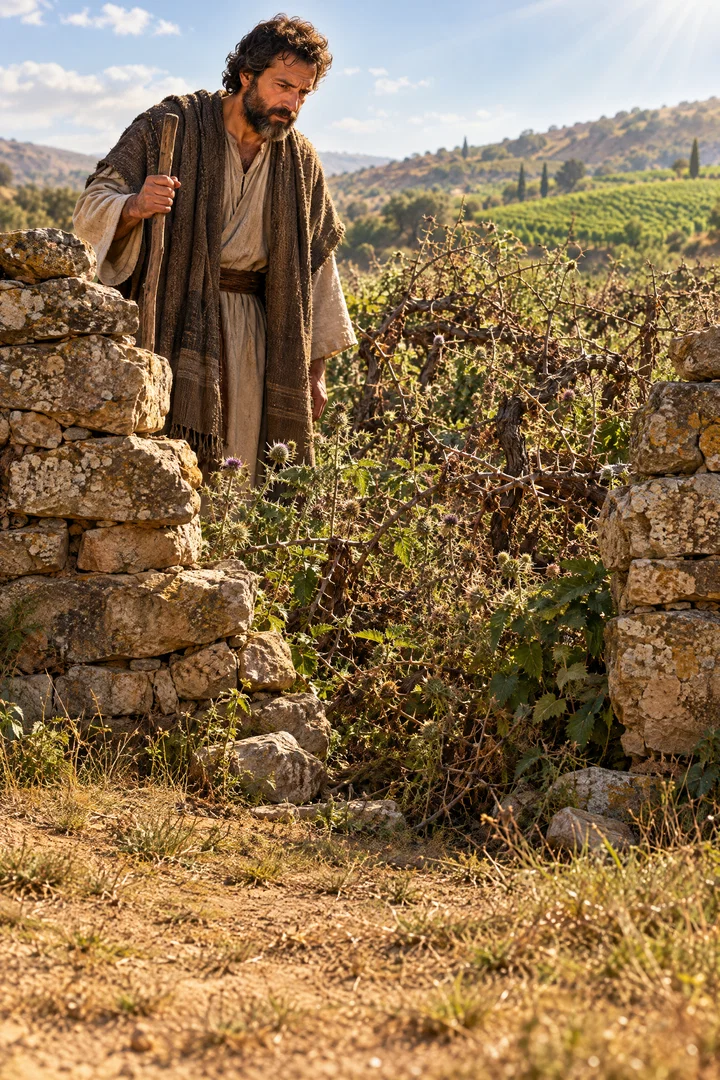
I went by the field of the slothful, and by the vineyard of the man void of understanding;
Translations
American King James Version, King James Version, Webster Bible, Revised Version
I went by the field of the slothful, and by the vineyard of the man void of understanding;
I went by the field of the slothful,
And by the vineyard of the man void of understanding;I went by the field of the sluggard,
And by the vineyard of the man void of understanding;Near the field of a slothful man I passed by, And near the vineyard of a man lacking heart.
I went by the field of a sluggard, and by the vineyard of a man void of understanding;
By the field of the sluggard, I passed, and by the vineyard of a man lacking sense;
Berean Standard Bible, Majority Standard Bible
I went past the field of a slacker
and by the vineyard of a man lacking judgment.I went by the field of the sluggard,
by the vineyard of the man void of understanding.I went by the field of the hater of work, and by the vine-garden of the man without sense;
I passed by the fielde of the slouthfull, and by the vineyarde of the man destitute of vnderstanding.
Douay-Rheims (Challoner revision)
I passed by the field of the slothful man, and by the vineyard of the foolish man:
Pictures
Cross-references
- Ecclesiastes 10:18
By much slothfulness the building decayeth; and through idleness of the hands the house droppeth through.
Both texts show that idleness leads to neglect and decay.
- Proverbs 6:6-11
Go to the ant, thou sluggard; consider her ways, and be wise:
Both warn that slothfulness leads to poverty.
- Proverbs 20:4
The sluggard will not plow by reason of the cold; therefore shall he beg in harvest, and have nothing.
Unwillingness to work leads to lack.
- Hebrews 6:12
That ye be not slothful, but followers of them who through faith and patience inherit the promises.
Warns against slothfulness and urges diligence.
- Proverbs 10:4-5
He becometh poor that dealeth with a slack hand: but the hand of the diligent maketh rich.
Both contrast diligence with idleness.
- Proverbs 18:9
He also that is slothful in his work is brother to him that is a great waster.
Links slackness in work with destructive behavior.
- Romans 12:11
Not slothful in business; fervent in spirit; serving the Lord;
Calls believers to be diligent rather than slothful.
- Proverbs 13:4
The soul of the sluggard desireth, and hath nothing: but the soul of the diligent shall be made fat.
Both contrast slothfulness with diligence.
- Proverbs 19:15
Slothfulness casteth into a deep sleep; and an idle soul shall suffer hunger.
Both warn that slothfulness leads to want.
Commentary
Each commentary is drawn from primary sources: the writings of Ellen G. White and Adventist pioneers and periodicals. Each commentary is separate. Its own words are not a quotation; follow the references to read the source passages.
Ellen G. White
6 sources
The field of the slothful and the vineyard of the man void of understanding stand as an example of neglect, showing that idleness and failure to tend one's responsibilities lead to disorder and loss, and the scene itself instructs in the consequences of sloth.5T 181.2–3 By joining the slothful with the one void of understanding, the verse teaches that idleness is folly and reveals a lack of understanding.GW 277.2COL 343.3 It warns against leaving one's work and abilities unused, for mind and body were made for active, earnest service, and spending daylight hours in needless sleep wastes precious time.GW 277.2 The Bible does not endorse idleness, for diligence in ordinary work belongs to true religion, and a truly converted person is a diligent worker.COL 343.3
Neglect of what is entrusted brings a harmful harvest, for as an uncultivated field grows briars and thorns, so neglect of the mind and heart deforms the character and leaves the person unhappy.ST May 20, 1913 The overgrown field with thorns and thistles also illustrates the training of children, where lack of discipline leaves them without guidance and lets wrongdoing grow.RH Jan 29, 1901 Spiritually, the inactive sluggard with folded hands pictures those who know that the last message of mercy is going to the world yet are asleep and do nothing in Christian help work, in contrast to those in other churches who walk in all the light they have and work actively and would do much more if they knew the truth.Lt 152, 1901, par. 6
Sources
Pioneers and periodicals
12 sources
The verse pictures a passerby looking on a field and vineyard left without care until thorns and nettles and briars cover the ground and its stone wall lies broken down.RH Oct 4, 1864RH Jan 10, 1907ST Feb 26, 1880 The ruin comes not by deliberate harm but by mere neglect, and the sloth that leaves the work undone shows and joins a want of understanding.RH Nov 13, 1900RH May 27, 1915ST Feb 26, 1880 Idleness is therefore forbidden and diligent labor is required, for giving way to sleep and folded hands lets neglect bring decay and poverty and want like a traveler and an armed man.RH Oct 4, 1864RH Jan 10, 1907RH Sep 3, 1872RH May 27, 1915 The neglected ground is also a parable of the soul and character, for the heart is a field that must be kept by constant striving and well-ordered thought, and if good intentions are left undone evil traits overgrow it and break down its defenses and leave it unhappy and rejected.ST May 20, 1913ST Aug 11, 1909 The same neglect allowed to grow in children without discipline, in lessons left untaught, and in the heart left to weeds such as jealousy from groundless surmising, is cured only by keeping the affections constantly given to Christ.RH Jan 29, 1901RH Jan 10, 1907ST Aug 1, 1916
The Field in Ruins
One going by the plot of a lazy holder and the vine-planting of a person without sense sees ground left without tending until neglect itself brings it to waste.RH Oct 4, 1864RH Jan 10, 1907ST Feb 26, 1880ST Aug 11, 1909ST Nov 27, 1893 Thorns spread over it, nettles cover its face, briars and thistles rise in place of crop, and its piled-stone enclosure lies tumbled and breached.ST May 20, 1913RH Oct 4, 1864RH Jan 10, 1907ST Aug 11, 1909ST Nov 27, 1893 The next verse completes the sight by joining the overgrowth to the broken wall as the joint outcome of the same neglect.RH Oct 4, 1864RH Jan 10, 1907ST Feb 26, 1880ST Aug 11, 1909ST Nov 27, 1893
The waste does not come because the holder set out to destroy it, but because he failed to keep it, so that weeds grow and defenses fall simply through want of care.ST Feb 26, 1880 This shows that ordered things do not stay in good condition by themselves but require steady active keeping.ST Feb 26, 1880 Laziness in work exposes want of judgment, and want of judgment clings to laziness, so that the slothful one is the one empty of understanding.RH Nov 13, 1900RH May 27, 1915 The sharp reproof of the idler fits one who himself understood fruitful labor and careful management.RH May 27, 1915
A forsaken cotton estate in Tahiti gives the same picture in life, where once fruitful acres and their mill had sunk into desolation.ST Nov 27, 1893 Its former master had died a victim of drink, leaving what had been productive to stand as a visible field of the slothful and vineyard of the man void of understanding.ST Nov 27, 1893
Sloth Rebuked, Diligence Required
Idleness is forbidden and labor and industry are required by what is seen in the field of the slothful and the vineyard of the man void of understanding left uncared for until overgrown with thorns and covered with nettles with its stone wall broken down.RH Oct 4, 1864 A little sleep, a little slumber and a little folding of the hands to sleep brings poverty as one that travels and want as an armed man.RH Oct 4, 1864 Sloth and lack of understanding leave field and vineyard and work neglected, and that neglect brings decay, poverty and ruin, pictured in the overgrowth and the broken wall that follow.RH Jan 10, 1907RH Sep 3, 1872RH May 27, 1915 The lesson is applied to education, where teachers should model doing their work thoroughly rather than leaving it undone.RH Jan 10, 1907
The neglected field and vineyard of the slothful, unwise man awakens to the danger of sleeping through important duties.RH Sep 3, 1872 It calls for faithful action in the work already at hand rather than waiting for a greater task or a special impulse.RH Sep 3, 1872 The rebuke of the sluggard reflects Solomon's own knowledge of productive work and thrift.RH May 27, 1915 Refusing to use the mind for a useful purpose is a form of sloth, just as refusing physical work leaves a person in poverty.ST Apr 14, 1887 Slovenliness and laziness do not belong with Christianity, for slothfulness that leaves a field neglected and overgrown reveals lack of understanding.RH Nov 13, 1900
Soul, Character, and Duty
The neglected ground covered with thorns and nettles with its protective wall broken down is a parable of the life and the soul and not only of farming.ST Aug 11, 1909 Letting the life alone without constant striving brings the same pitiable plight in the soul.ST Aug 11, 1909 There thorns, nettles and broken defenses mean decay, wickedness and rejection, while vigilance is the price of liberty, progress and acceptance.ST Aug 11, 1909
The heart is a field and vineyard that must be kept by well-ordered meditation and regulated thought. Outward acts are the ripe fruit of the inward frame of mind and daily meditation is its blossom. Keeping the heart requires constant care, yet it becomes less and less burdensome the more it is carried out in practice. If good intentions are not carried out, good thoughts quietly forsake a person until thorns and thistles cover the choice fields of the heart and its walls of defense are broken down.
Just as an uncultivated field grows briars and thorns, neglect of what has been entrusted in mind and heart deforms the character and leaves a person unhappy.ST May 20, 1913 The same lesson applies to children, because a lack of discipline leaves them without guidance and allows wrongdoing to grow like thorns and thistles.RH Jan 29, 1901 The warning that neglect brings decay applies to education, so teachers should model doing their work thoroughly.RH Jan 10, 1907
The vineyard overgrown with weeds pictures a heart garden overgrown with weeds, where weeds are of the earth earthy and flowers are of heavenly origin.ST Aug 1, 1916 The weeds mean evil traits, especially jealousy growing through neglect from senseless surmising.ST Aug 1, 1916 As when a husband suspects his wife without cause, it makes both miserable and wretched and fills untimely graves.ST Aug 1, 1916 The poison of jealousy is more virulent than poison ivy or poison oak because it can destroy the soul as well as the body, and it is not removed by marriage.ST Aug 1, 1916 The cure for the overgrown heart is godly jealousy that keeps the sincere affections constantly given to Christ and the mind stayed on Him, giving perfect peace.ST Aug 1, 1916 It makes little differences easy to adjust when husband and wife are one in Christ, and starves eavesdroppers, gossipers and scandal-mongers.ST Aug 1, 1916
Sources