Revelation 8:7
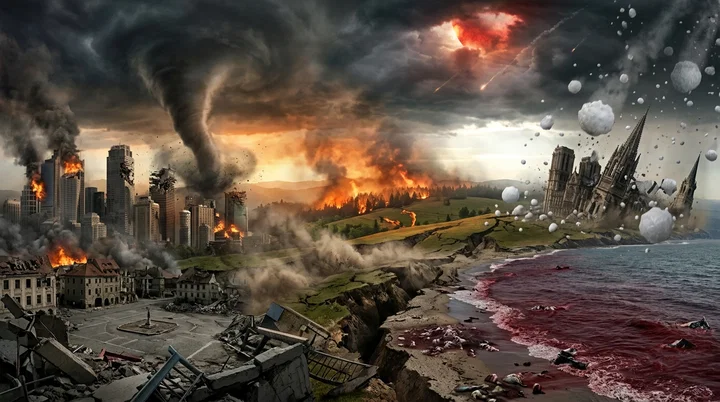
The first angel sounded, and there followed hail and fire mingled with blood, and they were cast upon the earth: and the third part of trees was burnt up, and all green grass was burnt up.
Translations
The first angel sounded, and there followed hail and fire mingled with blood, and they were cast on the earth: and the third part of trees was burnt up, and all green grass was burnt up.
King James Version, KJV Cambridge Paragraph Bible, Webster Bible
The first angel sounded, and there followed hail and fire mingled with blood, and they were cast upon the earth: and the third part of trees was burnt up, and all green grass was burnt up.
Revised Version, American Standard Version
And the first sounded, and there followed hail and fire, mingled with blood, and they were cast upon the earth: and the third part of the earth was burnt up, and the third part of the trees was burnt up, and all green grass was burnt up.
and the first messenger did sound, and there came hail and fire, mingled with blood, and it was cast to the land, and the third of the trees was burnt up, and all the green grass was burnt up.
And the first sounded [ his] trumpet: and there was hail and fire, mingled with blood, and they were cast upon the earth; and the third part of the earth was burnt up, and the third part of the trees was burnt up, and all green grass was burnt up.
And, the first, sounded; and there came to be hail and fire mingled with blood, and it was cast unto the earth; and, the third of the earth, was burned up, and, the third of the trees, was burned up, and, all green herbage, was burned up.
Berean Standard Bible, Majority Standard Bible
Then the first angel sounded his trumpet, and hail and fire mixed with blood were hurled down upon the earth. A third of the earth was burned up, along with a third of the trees and all the green grass.
The first sounded, and there followed hail and fire, mixed with blood, and they were thrown to the earth. One third of the earth was burned up, and one third of the trees were burned up, and all green grass was burned up.
And at the sounding of the first, a rain of ice and fire, mixed with blood, was sent on the earth: and a third part of the earth, and of the trees, and all green grass was burned up.
So the first Angell blewe the trumpet, and there was haile and fire, mingled with blood, and they were cast into the earth, and the thirde part of trees was burnt, and all greene grasse was burnt.
Douay-Rheims (Challoner revision)
And the first angel sounded the trumpet, and there followed hail and fire, mingled with blood, and it was cast on the earth, and the third part of the earth was burnt up, and the third part of the trees was burnt up, and all green grass was burnt up.
Pictures
Cross-references
- Revelation 9:4
And it was commanded them that they should not hurt the grass of the earth, neither any green thing, neither any tree; but only those men which have not the seal of God in their foreheads.
The command not to harm vegetation contrasts with the first trumpet’s burning of it.
- Revelation 8:2
And I saw the seven angels which stood before God; and to them were given seven trumpets.
Angels are given the seven trumpets before the first trumpet sounds.
- Revelation 8:12
And the fourth angel sounded, and the third part of the sun was smitten, and the third part of the moon, and the third part of the stars; so as the third part of them was darkened, and the day shone not for a third part of it, and the night likewise.
The fourth trumpet continues the sequence of judgments.
- Revelation 16
And I heard a great voice out of the temple saying to the seven angels, Go your ways, and pour out the vials of the wrath of God upon the earth.
The trumpet judgments are compared with the vials containing the final plagues.
- Revelation 7:1-4
And after these things I saw four angels standing on the four corners of the earth, holding the four winds of the earth, that the wind should not blow on the earth, nor on the sea, nor on any tree.
The servants are sealed before the winds bring harm to the earth and trees.
- Joel 2:1-11
Blow ye the trumpet in Zion, and sound an alarm in my holy mountain: let all the inhabitants of the land tremble: for the day of the LORD cometh, for it is nigh at hand;
The destructive army is connected with the coming day of the Lord.
- Revelation 6
And I saw when the Lamb opened one of the seals, and I heard, as it were the noise of thunder, one of the four beasts saying, Come and see.
The seals and trumpets are described as parallel prophetic sequences extending to the end of time.
Commentary
Each commentary is drawn from primary sources: the writings of Ellen G. White and Adventist pioneers and periodicals. Each commentary is separate. Its own words are not a quotation; follow the references to read the source passages.
Ellen G. White
2 sources
The first trumpet is one in a coming series of solemn events still future and yet to transpire upon the inhabitants of the earth, with trumpet sounding after trumpet and vial poured out after vial one after another.14MR 287.1Lt 112, 1890, par. 12–13 These trumpet events are of stupendous interest and are right upon us.Lt 112, 1890, par. 12–13 Their sounding takes place within a battle directed by the Captain of the Lord's host standing at the head of the angels of heaven.14MR 287.1
These events are sure indications of the presence of the One who has directed every aggressive advance, who has accompanied the march of His cause through all the ages, and who has pledged to be with His people in all their conflicts to the end of the world.Lt 112, 1890, par. 12–13 He will vindicate His truth and cause it to triumph.Lt 112, 1890, par. 12–13 Meeting what is described requires the power of the Holy Spirit upon God's people.14MR 287.1Lt 112, 1890, par. 12–13 He is ready to supply His faithful ones with motive and power of purpose, inspiring them with hope and courage and valor for increased activity because the time is at hand.Lt 112, 1890, par. 12–13
Sources
Pioneers and periodicals
69 sources
The first trumpet begins a sevenfold call to war that runs in fixed order from the breakup of Rome to the return of Christ, when the kingdoms of earth become His kingdom.ST Oct 24, 1911STST Feb 7, 1906 Its hail and fire mingled with blood were northern invaders sweeping down from frozen lands to slaughter the inhabitants and burn cities, farms and countryside, leaving the land a smoking ruin.RH Jul 8, 1858RH Aug 21, 1900ST Jan 10, 1878 Being cast upon the earth and burning trees and all green grass shows widespread and total devastation, while the third part measures its extent upon the western division of the empire.RH Dec 18, 1900RH Aug 21, 1900RH Dec 18, 1900RH Jul 8, 1858RH Sep 29, 1874 This was fulfilled when the Goths under Alaric ravaged from the Danube and Greece into Italy from 395 to 419, besieged and sacked Rome in 410, and opened the ruin continued by Vandals, Huns and Heruli to the downfall of Western Rome in 476.RH Jul 8, 1858ST Oct 31, 1916RH Aug 21, 1900RH Oct 27, 1874 The stroke was retribution upon Rome for persecution and for corruption through union with the apostate church, and these partial judgments foreshadow the final unmixed wrath and ruin of the world under the last plagues and the seventh trumpet.RH Dec 18, 1900RH Dec 29, 1868RH Mar 5, 1901RH Feb 11, 1873
Place Among Trumpets
The sounding here is the first of seven angels with seven trumpets, which come in fixed succession and together make a complete sevenfold call to battle.ST Oct 24, 1911STST Oct 31, 1916ST Feb 7, 1906 The trumpets are symbols of war, and the seven signifies completeness of the prophetic outline.STST Oct 31, 1916ST Feb 7, 1906ST Nov 7, 1916 The sequence opens with the breaking up of the great Roman Empire, passes through political darkness brought by the Saracens and Turks, and closes with worldwide wrath when the kingdoms of the earth become Christ's kingdom.ST Oct 24, 1911STST Feb 7, 1906 During this period of strife God's Word bears a double witness and the final phase of the gospel goes forth.ST Oct 24, 1911
The trumpets are introduced under the seventh seal, after silence in heaven, when fire from the altar is cast upon the earth with thunders and voices and lightnings and an earthquake, and the seven angels that stand before God are given trumpets and prepare themselves to sound.ST Aug 8, 1916ST Oct 29, 1912 The vision is set in the heavenly sanctuary where Christ ministers, and belongs to the portion concerning the seven trumpets which follows the seven churches, the seven seals, and the great sealing work of Revelation 3 through 9.ST Dec 8, 1909 The silence is a prophetic half hour, equated to seven and one-half literal days, while the angels leave their place around God's throne to accompany Christ to earth.ST Oct 29, 1912
The trumpet visions look back over the events covered by the seals and churches and give them in greater detail with other events added, spanning the Christian dispensation from the first advent and the first century to the consummation and Christ's coming in glory.ST May 2, 1916ST May 13, 1880ST Aug 8, 1916RH Jul 3, 1879ST Dec 16, 1908 They are synchronous with the seals and churches and mark periods also covered by them, rather than beginning only after them, with events following from causes shown in the preceding lines.RH Jul 3, 1879ST Dec 8, 1909RH Apr 14, 1904 They portray the history of earthly nations in conflict with one another, covering about the same period as the church's history and reaching to the judgment and the day of reward and retribution.ST May 13, 1880 The Lord's appearing and the kingdoms becoming Christ's are reserved to the seventh seal and seventh trumpet at the close.ST May 13, 1880ST Aug 8, 1916
The trumpets are mostly past political events to be interpreted in light of their historical records.RH Sep 29, 1874 Their language is not all to be read figuratively, but is to be taken literally unless there is good reason to take it as symbolic.RH Sep 29, 1874 The trumpet itself is not literally heard by inhabitants of the earth; events accomplished under the trumpet mark the transition from one angel to the next.RH Dec 21, 1869
The first four trumpets herald the fall of the Western Roman Empire and the means by which it was overthrown and ruined amid war and tumult.ST May 18, 1904ST Dec 17, 1896RH May 4, 1869RH Jul 15, 1858RH Jul 22, 1858 The first trumpet is the opening war bringing desolation upon the earth, a destructive sweep across the Roman world by the first of four attacks that shattered the Western Empire, with burning trees and grass marking its destruction.ST May 18, 1904RH Jul 15, 1858 The first six trumpet judgments are identified with the incursions of northern European barbarian tribes into the Roman Empire over many centuries.RH May 4, 1869 They are distinct from the later woes of the fifth and sixth trumpets upon apostate Christendom by the Saracens and Turks, and from the later command not to harm vegetation.RH Jul 15, 1858RH Jul 22, 1858 These trumpet judgments are partial divine judgments or plagues preceding the seven last plagues, which fill up God's wrath and make no exemption.RH Dec 29, 1868
Meaning of Symbols
Hail denotes invaders descending from the frozen regions of the north, even from the shores of the Baltic, while fire mingled with blood denotes the slaughter of the inhabitants and the burning and destruction of cities and countryside that marked their advance.RH Jul 8, 1858RH Aug 21, 1900ST Jan 10, 1878ST Nov 28, 1895RH Jul 8, 1858 The hail points to the northern origin of the warriors, the fire to the burning of cities and countryside, and the blood to the killing of the empire's people, together picturing armies of unknown barbarians dissolving the union of the Roman Empire, humbling it in the dust, and establishing victorious reign over its fairest provinces.RH Jul 8, 1858RH Aug 21, 1900ST Jan 10, 1878RH Jul 8, 1858 The storm falls as barbarians in the north and Vandals in the south with the wars that followed, bringing complete demoralization and ruin and desolation in their train.ST Mar 3, 1909ST Nov 28, 1895RH Jul 8, 1858 It is a storm of destruction upon the earth, with fields and settlements consumed by fire, people massacred, Rome pillaged and the empire broken.RH Aug 21, 1900RH Jul 8, 1858
Being cast upon the earth means widespread devastation across the land and provinces, and the burned trees mean the burning of the country itself.RH Aug 21, 1900RH Jul 8, 1858ST May 18, 1904 Regions covered with elegant houses and well-cultivated farms were suddenly changed into a desert distinguished only by smoking ruins, with forests and pastures turned to desolation and contemporary trees lamented as blazing in the conflagration of the whole country.RH Aug 21, 1900RH Oct 27, 1874RH Jul 8, 1858 The burning of all green grass emphasizes the total, withering effect of the sweep, leaving cultivated land and pastures desolate.RH Sep 29, 1874RH Oct 27, 1874RH Jul 8, 1858 In Greece this was aided by the dry season, which let the invaders ford streams while dried vegetation and forest trees burned when ignited, and by slaughter of the inhabitants.RH Sep 29, 1874RH Oct 27, 1874
The repeated third part points to a third part of the empire under the scourge, understood as its division into eastern, western and central parts.RH Dec 18, 1900RH Jul 8, 1858RH Mar 5, 1901ST May 18, 1904 It is also reckoned as the division into three parts under Constantine and among his three sons in 337, seven years after the capital moved to Constantinople in 330.RH Dec 18, 1900RH Mar 5, 1901ST May 18, 1904 The stroke applies chiefly to the western division, including Britain, Gaul and Spain, and is presented as a historical judgment especially directed against a nation and a part of Europe.RH Dec 18, 1900RH Dec 18, 1900RH Dec 18, 1900ST May 18, 1904 It measures the extent of desolation when a third, perhaps half, of the population of Europe and part of Africa was mown down by war, pestilence and famine.RH Jul 8, 1858RH Aug 21, 1900
Fulfillment in Fall of Rome
The first trumpet was fulfilled by the Gothic invasions under Alaric that began the breakup of the Roman Empire, dated to 395 or 396 through 419, when northern warriors brought slaughter and destruction by fire upon Roman lands and cities.RH Jul 8, 1858ST Oct 31, 1916RH Aug 21, 1900ST Nov 7, 1916 Hail pointed to the invaders' northern origin from the frozen regions, fire to the burning of cities and countryside, and blood mingled with fire to the killing of the inhabitants, while the burned trees and all green grass depicted the devastation of the invasion turning elegant houses, cultivated farms, forests and pastures into smoking ruins and desert.RH Jul 8, 1858RH Aug 21, 1900RH Dec 18, 1900 The wars waged by Alaric and his victorious Goths pillaged Rome and humbled it in the dust, dissolving the union of the empire and establishing victorious reign over its fairest provinces in Europe and Africa.RH Aug 21, 1900RH Dec 18, 1900 The trumpet itself is a symbol of war against the empire, and the first storm against it marked its first fall, with fire and destruction on land bringing retribution on Rome for its persecution of Christ and God's people.ST Oct 31, 1916RH Dec 18, 1900RH Jul 8, 1858RH Jul 8, 1858
After the death of Theodosius in 395 the Goths ravaged provinces from the Danube and Greece into Italy, threatening Rome and forcing Emperor Honorius to flee.RH Aug 21, 1900RH Jul 8, 1858 The Visigoths under Alaric overran Greece and devastated the north, where the dry season let them ford streams and dried vegetation and forest trees burned when ignited, while the inhabitants were slaughtered.RH Sep 29, 1874RH Jul 8, 1858RH Jul 8, 1858 A great host of unknown barbarians under Radagaisus brought destruction from Germany into Italy and Gaul, where cities were pillaged or destroyed, Christians were massacred, and the peaceful countryside was turned into smoking ruins.RH Aug 21, 1900RH Jul 8, 1858 After an earlier defeat Alaric returned to Italy, besieged and sacked Rome in 410 and died that year, and the Goths left Italy in 412.RH Jul 8, 1858
The devastation was carried out not only by the Visigoths under Alaric and his brother through 414 but also by other northern peoples overrunning the middle and western divisions during the same period, with widespread devastation cast upon the earth across those divisions.RH Oct 27, 1874RH Sep 29, 1874 The hail and fire symbolize invasions by the barbarians in the north and the Vandals in the south and the consequent wars that followed, which resulted in the complete demoralization of the empire, leaving cultivated land and pastures desolate with total, withering effect.ST Mar 3, 1909RH Oct 27, 1874 The sequence continues with the Vandals under Genseric, the Huns under Attila, and the Heruli under Odoacer, to whom with Alaric belongs an important prophetic place in hastening the ruin of the empire, ending with the downfall of Western Rome in 476.RH Aug 14, 1900RH Apr 14, 1903 The first four trumpets portray the terrible invasions that ruined Western Rome and helped establish the ten kingdoms in its territory from which the nations dominant in modern history arose, depicting the invasions themselves rather than the planting of the kingdoms, while also marking the rise and establishment of an apostasy from genuine Christianity that has opposed God's kingdom for centuries.RH Aug 14, 1900RH Apr 14, 1903
The trumpets were fulfilled in the breakup of the empire as judgments upon Rome for rejecting light and putting the Son of God to death, showing the results of governments that reject great light.RH Dec 18, 1900RH Mar 5, 1901RH May 21, 1901 Waves of northern barbarian invasions swept away the corruption that had accumulated in the empire through its union with the apostate church and the making of the papacy, contributing to its complete ruin.RH Apr 14, 1903RH Aug 7, 1900 The seven-trumpet prophecy predicts this breaking up as the scourge of God upon apostasy, part of the consequences of wrong principles of government that God permits to develop among the nations.RH Mar 5, 1901ST Apr 11, 1911
Prophetic Scope and Timing
The seven trumpets present a complete successive outline of political events from the breaking up of the great Roman Empire to Christ's return in glory, when worldwide wrath comes and the kingdoms of the earth become Christ's kingdom.ST Oct 24, 1911STST Feb 7, 1906 The number seven signifies the completeness of this prophetic account, and the trumpets sound in fixed succession, opening with the first trumpet and continuing through the Lord's coming, the resurrection and the kingdom.STST Feb 7, 1906RH Apr 7, 1863 They cover about the same period as the churches and seals, from the first century and the first advent to the consummation, portraying the history of earthly nations in conflict and reaching to the judgment and the day of reward and retribution.ST May 13, 1880RH May 6, 1873RH Jul 23, 1872 The series portrays events in the decline and fall of the Roman Empire, beginning with its first invasion by the Goths under Alaric in A.D. 395, followed by political darkness brought by the Saracens and Turks.ST Oct 24, 1911STST Jan 15, 1880 The visions portray a time of peril and spiritual decline, not a converted world, extending to the end of the age, with the final three trumpets as woes upon the earth.ST Oct 24, 1911ST Apr 8, 1886
The first trumpet covers the years 395 to 419 and describes the invasions of the Visigoths, especially under Alaric, and the great horde of barbarians under Radagaisus.RH Aug 21, 1900ST Jan 15, 1880 The hail and fire mingled with blood cast upon the earth are armies of unknown barbarians issuing from the frozen regions of the north, dissolving the union of the Roman Empire, humbling its genius in the dust, and establishing victorious reign over the fairest provinces of Europe and Africa.RH Aug 21, 1900 The burning of the third part of the trees is the burning of the country itself, where regions covered with elegant houses and well-cultivated farms were suddenly changed into a desert distinguished only by smoking ruins.RH Aug 21, 1900 The wider prophecy of the seven trumpets in Revelation 8 to 11, including the two witnesses of Revelation 11, contains the 1,260 years of persecution from A.D. 538 to 1798, the five months of Ottoman pressure beginning July 27, 1299 and reaching to 1449 when Constantinople became subject to the Turks, and 391 years and 15 days from thence to August 11, 1840 when Turkey lost her independence by voluntary surrender to the great powers of Europe and became known as the Sick Man of the East.ST Nov 28, 1895 The next great events in this prophecy after those dates are the judgment, the day of God's wrath, and the coming of Christ.ST Nov 28, 1895
The trumpets belong with eight great lines of prophecy including Daniel 2, Daniel 7, Daniel 8 with its 2,300 days to 1844, Daniel 11, the seven seals of Revelation 6-8, and Revelation 12 and 13, all given as multiplied converging evidence that Christ's coming is near.ST Jul 8, 1897ST Aug 14, 1893ST Nov 28, 1900 The last and next event in all of them is the coronation of Jesus Christ as coming King.ST Jul 8, 1897 The seven-trumpet prophecy adds events not described as fully in Daniel, sets forth the breaking up of the Roman kingdom and confirms its division into ten parts, gives details about the kingdoms into which the fourth universal empire was divided, and includes the plague of Mohammedanism with the duration of the Mohammedan powers and the closing work of God's judgment.ST Nov 8, 1905 It bears on the Eastern Question and the rise of Turkish power fulfilled to the very day, and with the two witnesses and the 1260, five-month and 391-year periods provides further evidence for recognizing when the world's history is nearing its end.ST Jul 8, 1897ST Nov 28, 1900
The trumpet prophecy commences in Revelation 8, continues through Revelation 9, and is resumed in Revelation 11:19, forming one series ending with the seventh trumpet.RH Dec 15, 1863 Its sounding has been reached as part of present truth, the first six trumpets being past while the seventh began to sound in 1844.RH Dec 15, 1863RH May 6, 1873 The seven trumpets with the seven seals span from Christ's first advent to the final restitution and relate especially to nations connected with God's people.RH May 6, 1873RH Jul 23, 1872 During this period of strife God's Word bears a double witness and the final phase of the gospel goes forth.ST Oct 24, 1911
In one account the seven trumpets occupy a shorter section of history than the preceding vision, and their beginning is left undetermined there, though the first trumpet begins a chronological succession continuing through the Lord's coming, the resurrection, and the kingdom.RH Apr 7, 1863 With the seven seals they cover the Christian dispensation from its commencement to its close, with the first trumpet early in that history.RH Apr 7, 1863RH Jul 23, 1872 The Lord appearing in the clouds with every eye beholding him and the kingdoms of this world becoming the kingdom of the Lord and of his Christ do not occur until the seventh seal is broken and the seventh trumpet sounds at the close.RH Jul 23, 1872 The trumpet line is connected with the Third Angel's Message and named among the prophetic histories that support the proclamation of the first angel, which belongs to the final work of the gospel and coincides with preaching the coming kingdom and the announcement that God's judgment has come.RH Aug 14, 1856RH Aug 7, 1900
Warning and Application
The trumpets are partial judgments, called plagues, that come before the seven last plagues in which God's wrath is filled up without exemption.RH Dec 29, 1868 They set forth more fully the severe and terrible judgments that precede the second advent of the Son of man and foreshadow what will take place at the revelation of Jesus Christ.RH Feb 11, 1873
As the flood destroyed the ungodly world in Noah's day and fire and brimstone fell on Sodom and the cities of the plain in Lot's day, so this trumpet signals great catastrophe and judgment coming upon human society in the course of history, still future to that warning, for which men will be as unprepared as they were then.RH Feb 11, 1873 The coming of the Son of man brings both salvation and judgment, introducing great changes and removing all that hinders the kingdom, so these prophecies have practical effect and call for watching and praying.RH Feb 11, 1873 The seven trumpets opened here are God's means of arousing mankind through the breaking up of the nations in the great controversy between the church and her foes from the first advent of Christ to the glorious consummation.ST Oct 20, 1909 They form one of seven great time dramas running to the end and one of twelve great lines of prophecy beginning in widely spread periods in the past but gathering their ends in the time of the end and the second coming of Jesus the Messiah, closing with the downfall of the false and the everlasting triumph of the true.ST Oct 20, 1909 They thus give multiplied evidence of the transitory nature of earthly dominion and lead God's children through all earthly troubles to His eternal, unchangeable, glorious kingdom of righteousness, standing among the warnings of coming judgments and dangers that are to be heeded.ST Oct 20, 1909ST Nov 1, 1910
The trumpets give the history of political powers used as a scourge against the church because of apostasy, with the first four marking the attacks of the barbarians upon the Western Roman Empire and its utter ruin by the armies of the northern peoples.RH Aug 7, 1900RH Oct 1, 1914 That ruin began with the Visigoths under Alaric in A.D. 395, followed by the Vandals under Genseric, the Huns under Attila, and the Heruli under Odoacer, ending with the downfall of Western Rome in 476.RH Oct 1, 1914 The same first four trumpets mark the downfall of the Western Empire and the setting up of the ten kingdoms from which the nations dominant in modern history arose, and mark also the rise and establishment of an apostasy from genuine Christianity that has for centuries opposed the establishment of God's kingdom on earth.RH Apr 14, 1903 Covering about the same time as the seven churches and the seven seals and spanning the Christian dispensation to Christ's coming in glory, the trumpet series shows God's wrath falling on apostate persecuting powers and their followers as the permitted consequence of wrong principles of government developing among the nations.ST Oct 14, 1889ST Apr 11, 1911 This historic ruin of Rome stands in contrast to the future ruin of the world under the seventh trumpet, following the making and worship of the image of the Beast.RH Aug 7, 1900
The verse portrays judgment falling on the earth through storms of fire and blood, with hail, fire, and blood flooding the land with destructive judgments and representing the fullness of woes upon the earth.RH Jul 13, 1911ST May 31, 1877ST May 12, 1881 It points to the destruction of antichrist and infidelity before Christ's kingdom is fully established.ST May 31, 1877 It points also to a coming time of trouble in which the world suffers woes as God withdraws behind a veil.RH Jul 13, 1911 Its fulfillment is among the trumpet signs showing that probation is nearing its close and that the world was approaching the time when a great voice from the temple and throne in heaven would declare, It is done.RH Jan 21, 1858RH Mar 18, 1858
The hail and fire are the invasions by the barbarians in the north and the Vandals in the south and the wars that followed, resulting in the complete demoralization of the Roman kingdom, and the verse does not refer to recent trouble in Italy nor to the falling of the city Babylon, which is a future event of much different and much vaster extent.ST Mar 3, 1909 Those who held the minority reading applied the first trumpet here described to the great Advent movement of 1844.RH Dec 2, 1873 Another slight notice treated the apocalyptic trumpet imagery only as marking the age as one of upheaval and major change, without further meaning.RH Jun 29, 1911
Sources