Jesus continued: “That which is born of the flesh is flesh; and that which is born of the Spirit is spirit.” By nature the heart is evil, and “who can bring a clean thing out of an unclean? not one.” No human invention can find a remedy for the sinning soul. “The carnal mind is enmity against God; for it is not subject to the law of God, neither indeed can be.” “Out of the heart proceed evil thoughts, murders, adulteries, fornications, thefts, false witness, blasphemies.” The fountain of the heart must be purified before the streams can become pure. He who is trying to reach heaven by his own works in keeping the law, is attempting an impossibility. There is no safety for one who has merely a legal religion, a form of godliness. The Christian’s life is not a modification or improvement of the old, but a transformation of nature. There is a death to self and sin, and a new life altogether. This change can be brought about only by the effectual working of the Holy Spirit.
Nicodemus was still perplexed, and Jesus used the wind to illustrate His meaning: “The wind bloweth where it listeth, and thou hearest the sound thereof, but canst not tell whence it cometh and whither it goeth: so is every one that is born of the Spirit.”
The wind is heard among the branches of the trees, rustling the leaves and flowers; yet it is invisible, and no man knows whence it comes, or whither it goes. So with the work of the Holy Spirit upon the heart. It can no more be explained than can the movements of the wind. A person may not be able to tell the exact time or place, or to trace all the circumstances in the process of conversion; but this does not prove him to be unconverted. By an agency as unseen as the wind, Christ is constantly working upon the heart. Little by little, perhaps unconsciously to the receiver, impressions are made that tend to draw the soul to Christ. These may be received through meditating upon Him, through reading the Scriptures, or through hearing the word from the living preacher. Suddenly, as the Spirit comes with more direct appeal, the soul gladly surrenders itself to Jesus. By many this is called sudden conversion; but it is the result of long wooing by the Spirit of God,—a patient, protracted process.
While the wind is itself invisible, it produces effects that are seen and felt. So the work of the Spirit upon the soul will reveal itself in every act of him who has felt its saving power. When the Spirit of God takes173possession of the heart, it transforms the life. Sinful thoughts are put away, evil deeds are renounced; love, humility, and peace take the place of anger, envy, and strife. Joy takes the place of sadness, and the countenance reflects the light of heaven. No one sees the hand that lifts the burden, or beholds the light descend from the courts above. The blessing comes when by faith the soul surrenders itself to God. Then that power which no human eye can see, creates a new being in the image of God.
It is impossible for finite minds to comprehend the work of redemption. Its mystery exceeds human knowledge; yet he who passes from death to life realizes that it is a divine reality. The beginning of redemption we may know here through a personal experience. Its results reach through the eternal ages.
While Jesus was speaking, some gleams of truth penetrated the ruler’s mind. The softening, subduing influence of the Holy Spirit impressed his heart. Yet he did not fully understand the Saviour’s words. He was not so much impressed by the necessity of the new birth as by the manner of its accomplishment. He said wonderingly, “How can these things be?”
“Art thou a master of Israel, and knowest not these things?” Jesus asked. Surely one entrusted with the religious instruction of the people should not be ignorant of truths so important. His words conveyed the lesson that instead of feeling irritated over the plain words of truth, Nicodemus should have had a very humble opinion of himself, because of his spiritual ignorance. Yet Christ spoke with such solemn dignity, and both look and tone expressed such earnest love, that Nicodemus was not offended as he realized his humiliating condition.
But as Jesus explained that His mission on earth was to establish a spiritual instead of a temporal kingdom, His hearer was troubled. Seeing this, Jesus added, “If I have told you earthly things, and ye believe not, how shall ye believe, if I tell you of heavenly things?” If Nicodemus could not receive Christ’s teaching, illustrating the work of grace upon the heart, how could he comprehend the nature of His glorious heavenly kingdom? Not discerning the nature of Christ’s work on earth, he could not understand His work in heaven.
The Jews whom Jesus had driven from the temple, claimed to be children of Abraham, but they fled from the Saviour’s presence because they could not endure the glory of God which was manifested in Him. Thus they gave evidence that they were not fitted by the grace of God to participate in the sacred services of the temple. They were zealous to174maintain an appearance of holiness, but they neglected holiness of heart. While they were sticklers for the letter of the law, they were constantly violating its spirit. Their great need was that very change which Christ had been explaining to Nicodemus,—a new moral birth, a cleansing from sin, and a renewing of knowledge and holiness.
There was no excuse for the blindness of Israel in regard to the work of regeneration. Under the inspiration of the Holy Spirit, Isaiah had written, “We are all as an unclean thing, and all our righteousnesses are as filthy rags.” David had prayed, “Create in me a clean heart, O God; and renew a right spirit within me.” And through Ezekiel the promise had been given, “A new heart also will I give you, and a new spirit will I put within you; and I will take away the stony heart out of your flesh, and I will give you an heart of flesh. And I will put My Spirit within you, and cause you to walk in My statutes.”
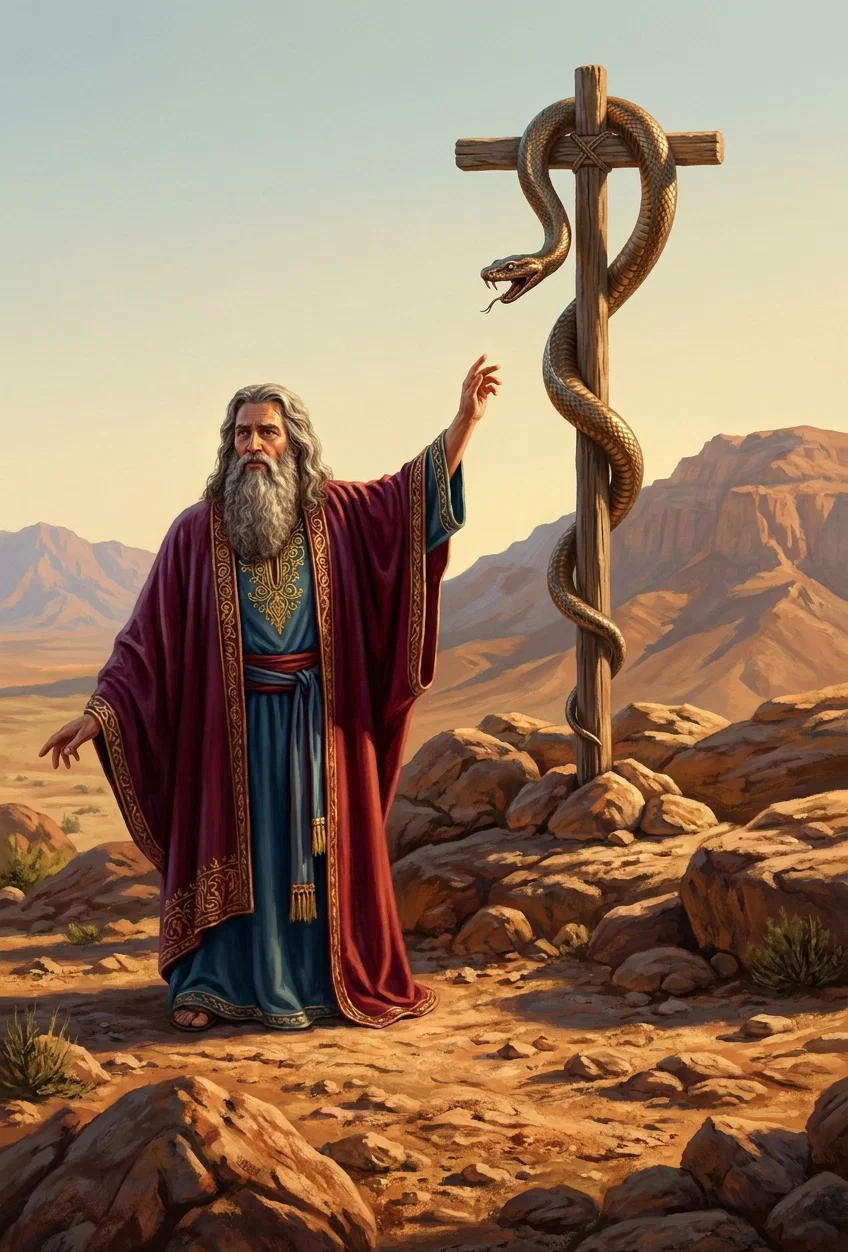
"As Moses lifted up the serpent in the wilderness, even so must the Son of man be lifted up."
Nicodemus had read these scriptures with a clouded mind; but he now began to comprehend their meaning. He saw that the most rigid obedience to the mere letter of the law as applied to the outward life, could entitle no man to enter the kingdom of heaven. In the estimation of men, his life had been just and honorable; but in the presence of Christ he felt that his heart was unclean, and his life unholy.
Nicodemus was being drawn to Christ. As the Saviour explained to him concerning the new birth, he longed to have this change wrought in himself. By what means could it be accomplished? Jesus answered the unspoken question: “As Moses lifted up the serpent in the wilderness, even so must the Son of man be lifted up; that whosoever believeth in Him should not perish, but have eternal life.”
Here was ground with which Nicodemus was familiar. The symbol of the uplifted serpent made plain to him the Saviour’s mission. When the people of Israel were dying from the sting of the fiery serpents, God175directed Moses to make a serpent of brass, and place it on high in the midst of the congregation. Then the word was sounded throughout the encampment that all who would look upon the serpent should live. The people well knew that in itself the serpent had no power to help them. It was a symbol of Christ. As the image made in the likeness of the destroying serpents was lifted up for their healing, so One made “in the likeness of sinful flesh” was to be their Redeemer. Many of the Israelites regarded the sacrificial service as having in itself virtue to set them free from sin. God desired to teach them that it had no more value than that serpent of brass. It was to lead their minds to the Saviour. Whether for the healing of their wounds or the pardon of their sins, they could do nothing for themselves but show their faith in the Gift of God. They were to look and live.
Those who had been bitten by the serpents might have delayed to look. They might have questioned how there could be efficacy in that brazen symbol. They might have demanded a scientific explanation. But no explanation was given. They must accept the word of God to them through Moses. To refuse to look, was to perish.
Not through controversy and discussion is the soul enlightened. We must look and live. Nicodemus received the lesson, and carried it with him. He searched the Scriptures in a new way, not for the discussion of a theory, but in order to receive life for the soul. He began to see the kingdom of heaven as he submitted himself to the leading of the Holy Spirit.
There are thousands to-day who need to learn the same truth that was taught to Nicodemus by the uplifted serpent. They depend on their obedience to the law of God to commend them to His favor. When they are bidden to look to Jesus, and believe that He saves them solely through His grace, they exclaim, “How can these things be?”
Like Nicodemus, we must be willing to enter into life in the same way as the chief of sinners. Then Christ, “there is none other name under heaven given among men, whereby we must be saved.” Through faith we receive the grace of God; but faith is not our Saviour. It earns nothing. It is the hand by which we lay hold upon Christ, and appropriate His merits, the remedy for sin. And we cannot even repent without the aid of the Spirit of God. The Scripture says of Christ, “Him hath God exalted with His right hand, to be a Prince and a Saviour, for to give repentance to Israel, and forgiveness of sins.” Repentance comes from Christ as truly as does pardon.
How, then, are we to be saved?—“As Moses lifted up the serpent in the wilderness,” so the Son of man has been lifted up, and every one who has been deceived and bitten by the serpent, may look and live. “Behold the Lamb of God, which taketh away the sin of the world.” The light shining from the cross reveals the love of God. His love is drawing us to Himself. If we do not resist this drawing, we shall be led to the foot of the cross in repentance for the sins that have crucified the Saviour. Then the Spirit of God through faith produces a new life in the soul. The thoughts and desires are brought into obedience to the will of Christ. The heart, the mind, are created anew in the image of Him who works in us to subdue all things to Himself. Then the law of God is written in the mind and heart, and we can say with Christ, “I delight to do Thy will, O my God.”
In the interview with Nicodemus, Jesus unfolded the plan of salvation, and His mission to the world. In none of His subsequent discourses did He explain so fully, step by step, the work necessary to be done in the hearts of all who would inherit the kingdom of heaven. At the very beginning of His ministry He opened the truth to a member of the Sanhedrim, to the mind that was most receptive, and to an appointed teacher of the people. But the leaders of Israel did not welcome the light. Nicodemus hid the truth in his heart, and for three years there was little apparent fruit.
But Jesus was acquainted with the soil into which He cast the seed. The words spoken at night to one listener in the lonely mountain were not lost. For a time Nicodemus did not publicly acknowledge Christ, but he watched His life, and pondered His teachings. In the Sanhedrim council he repeatedly thwarted the schemes of the priests to destroy Him. When at last Jesus was lifted up on the cross, Nicodemus remembered the teaching upon Olivet: “As Moses lifted up the serpent in the wilderness, even so must the Son of man be lifted up; that whosoever believeth in Him should not perish, but have eternal life.” The light from that secret interview illumined the cross upon Calvary, and Nicodemus saw in Jesus the world’s Redeemer.
After the Lord’s ascension, when the disciples were scattered by persecution, Nicodemus came boldly to the front. He employed his wealth in sustaining the infant church that the Jews had expected to be blotted out at the death of Christ. In the time of peril he who had been so cautious and questioning, was firm as a rock, encouraging the faith of the disciples, and furnishing means to carry forward the work of the gospel.177He was scorned and persecuted by those who had paid him reverence in other days. He became poor in this world’s goods; yet he faltered not in the faith which had its beginning in that night conference with Jesus.
Nicodemus related to John the story of that interview, and by his pen it was recorded for the instruction of millions. The truths there taught are as important to-day as they were on that solemn night in the shadowy mountain, when the Jewish ruler came to learn the way of life from the lowly Teacher of Galilee.178For a time the Baptist’s influence over the nation had been greater than that of its rulers, priests, or princes. If he had announced himself as the Messiah, and raised a revolt against Rome, priests and people would have flocked to his standard.
THE MUST INCREASE
CHAPTER EIGHTEEN.
Every consideration that appeals to the ambition of the world’s conquerors, Satan had stood ready to urge upon John the Baptist. But with the evidence before him of his power, he had steadfastly refused the splendid bribe. The attention which was fixed upon him, he had directed to Another.
Now he saw the tide of popularity turning away from himself to the Saviour. Day by day the crowds about him lessened. When Jesus came from Jerusalem to the region about Jordan, the people flocked to hear Him. The number of His disciples increased daily. Many came for baptism, and while Christ Himself did not baptize, He sanctioned the administration of the ordinance by His disciples. Thus He set His seal upon the mission of His forerunner. But the disciples of John looked with jealousy upon the growing popularity of Jesus. They stood ready to criticize His work, and it was not long before they found occasion. A question arose between them and the Jews as to whether baptism availed to cleanse the soul from sin; they maintained that the baptism of Jesus differed essentially from that of John. Soon they were in dispute with Christ’s disciples in regard to the form of words proper to use at baptism, and finally as to the right of the latter to baptize at all.
The disciples of John came to him with their grievances, saying, “Rabbi, He that was with thee beyond Jordan, to whom thou bearest witness, behold, the same baptizeth, and all men come to Him.” Through179these words, Satan brought temptation upon John. Though John’s mission seemed about to close, it was still possible for him to hinder the work of Christ. If he had sympathized with himself, and expressed grief or disappointment at being superseded, he would have sown the seeds of dissension, would have encouraged envy and jealousy, and would seriously have impeded the progress of the gospel.
John had by nature the faults and weaknesses common to humanity, but the touch of divine love had transformed him. He dwelt in an atmosphere uncontaminated with selfishness and ambition, and far above the miasma of jealousy. He manifested no sympathy with the dissatisfaction of his disciples, but showed how clearly he understood his relation to the Messiah, and how gladly he welcomed the One for whom he had prepared the way.
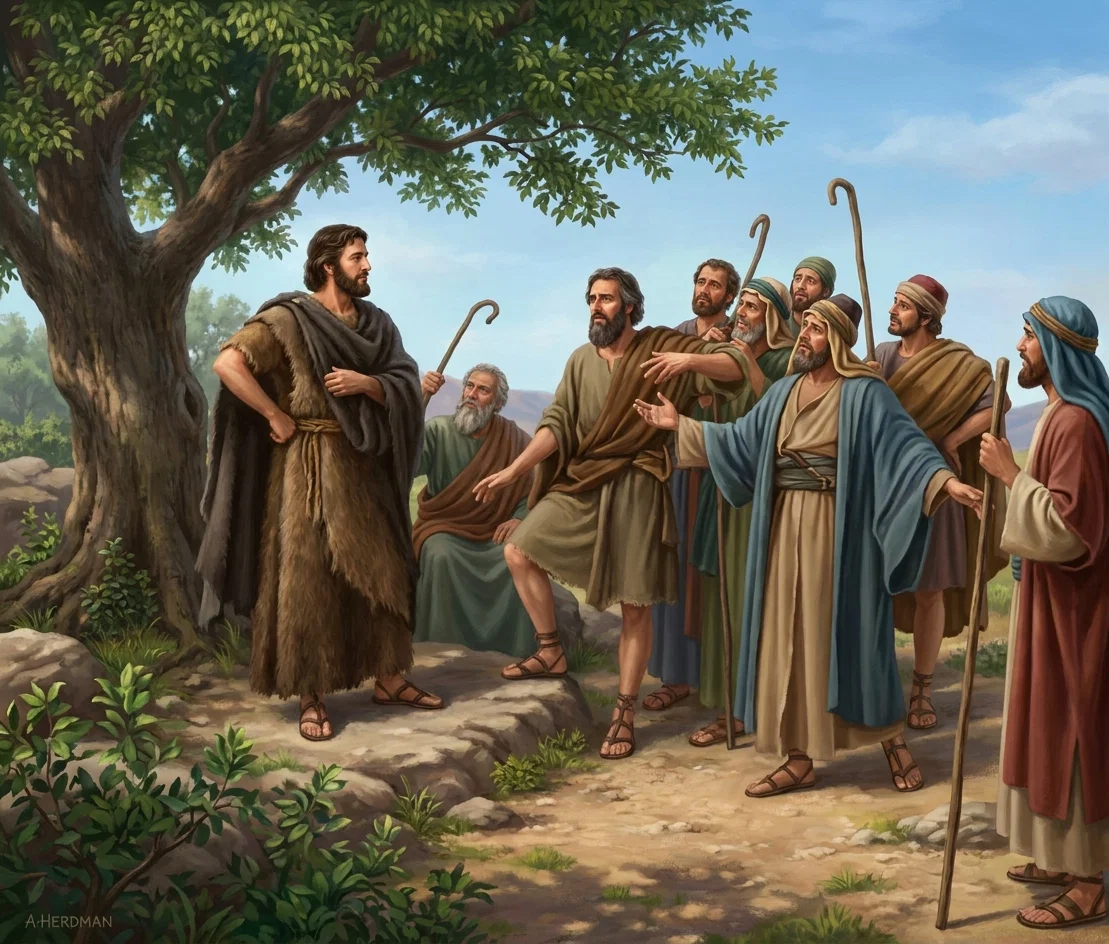
“The disciples of John came to him with their grievances.”
He said, “A man can receive nothing, except it be given him from heaven. Ye yourselves bear me witness, that I said, I am not the Christ, but that I am sent before Him. He that hath the bride is the bridegroom. But the friend of the bridegroom, which standeth and heareth him, rejoiceth greatly because of the bridegroom’s voice.” John represented himself as the friend who acted as a messenger between the180betrothed parties, preparing the way for the marriage. When the bridegroom had received his bride, the mission of the friend was fulfilled. He rejoiced in the happiness of those whose union he had promoted. So John had been called to direct the people to Jesus, and it was his joy to witness the success of the Saviour’s work. He said, “This my joy therefore is fulfilled. He must increase, but I must decrease.”
Looking in faith to the Redeemer, John had risen to the height of self-abnegation. He sought not to attract men to himself, but to lift their thoughts higher and still higher, until they should rest upon the Lamb of God. He himself had been only a voice, a cry in the wilderness. Now with joy he accepted silence and obscurity, that the eyes of all might be turned to the Light of life.
Those who are true to their calling as messengers for God, will not seek honor for themselves. Love for self will be swallowed up in love for Christ. No rivalry will mar the precious cause of the gospel. They will recognize that it is their work to proclaim, as did John the Baptist, “Behold the Lamb of God, which taketh away the sin of the world.” They will lift up Jesus, and with Him humanity will be lifted up. “Thus saith the high and lofty One that inhabiteth eternity, whose name is Holy: I dwell in the high and holy place, with him also that is of a contrite and humble spirit, to revive the spirit of the humble, and to revive the heart of the contrite ones.”
The soul of the prophet, emptied of self, was filled with the light of the divine. As he witnessed to the Saviour’s glory, his words were almost a counterpart of those that Christ Himself had spoken in His interview with Nicodemus. John said, “He that cometh from above is above all: he that is of the earth is earthly, and speaketh of the earth: He that cometh from heaven is above all. . . . For He whom God hath sent speaketh the words of God: for God giveth not the Spirit by measure unto Him.” Christ could say, “I seek not Mine own will, but the will of the Father which hath sent Me.” To Him it is declared, “Thou hast loved righteousness, and hated iniquity; therefore God, even Thy God, hath anointed Thee with the oil of gladness above Thy fellows.” The Father “giveth not the Spirit by measure unto Him.”
So with the followers of Christ. We can receive of heaven’s light only as we are willing to be emptied of self. We cannot discern the character of God, or accept Christ by faith, unless we consent to the bringing into captivity of every thought to the obedience of Christ. To all who do this, the Holy Spirit is given without measure.181In Christ “dwelleth all the fulness of the Godhead bodily, and in Him ye are made full.”
The disciples of John had declared that all men were coming to Christ; but with clearer insight, John said, “No man receiveth His witness;” so few were ready to accept Him as the Saviour from sin. But “he that hath received His witness hath set his seal to this, that God is true.” “He that believeth on the Son hath everlasting life.” No need of disputation as to whether Christ’s baptism or John’s purified from sin. It is the grace of Christ that gives life to the soul. Apart from Christ, baptism, like any other service, is a worthless form. “He that believeth not the Son shall not see life.”
The success of Christ’s work, which the Baptist had received with such joy, was reported also to the authorities at Jerusalem. The priests and rabbis had been jealous of John’s influence as they saw the people leaving the synagogues and flocking to the wilderness; but here was One who had still greater power to attract the multitudes. Those leaders in Israel were not willing to say with John, “He must increase, but I must decrease.” They arose with a new determination to put an end to the work that was drawing the people away from them.
Jesus knew that they would spare no effort to create a division between His own disciples and those of John. He knew that the storm was gathering which would sweep away one of the greatest prophets ever given to the world. Wishing to avoid all occasion for misunderstanding or dissension, He quietly ceased His labors, and withdrew to Galilee. We also, while loyal to truth, should try to avoid all that may lead to discord and misapprehension. For whenever these arise, they result in the loss of souls. Whenever circumstances occur that threaten to cause division, we should follow the example of Jesus and of John the Baptist.
John had been called to lead out as a reformer. Because of this, his disciples were in danger of fixing their attention upon him, feeling that the success of the work depended upon his labors, and losing sight of the fact that he was only an instrument through which God had wrought. But the work of John was not sufficient to lay the foundation of the Christian church. When he had fulfilled his mission, another work was to be done, which his testimony could not accomplish. His disciples did not understand this. When they saw Christ coming in to take the work, they were jealous and dissatisfied.
The same dangers still exist. God calls a man to do a certain work; and when he has carried it as far as he is qualified to take it, the Lord182brings in others, to carry it still farther. But, like John’s disciples, many feel that the success of the work depends on the first laborer. Attention is fixed upon the human instead of the divine, jealousy comes in, and the work of God is marred. The one thus unduly honored is tempted to cherish self-confidence. He does not realize his dependence on God. The people are taught to rely on man for guidance, and thus they fall into error, and are led away from God.
The work of God is not to bear the image and superscription of man. From time to time the Lord will bring in different agencies, through whom His purpose can best be accomplished. Happy are they who are willing for self to be humbled, saying with John the Baptist, “He must increase, but I must decrease.”183On the way to Galilee Jesus passed through Samaria. It was noon when He reached the beautiful vale of Shechem. At the opening of this valley was Jacob’s well. Wearied with His journey, He sat down here to rest while His disciples went to buy food.
AT JACOB'S WELL
CHAPTER NINETEEN.
The Jews and the Samaritans were bitter enemies, and as far as possible avoided all dealing with each other. To trade with the Samaritans in case of necessity was indeed counted lawful by the rabbis; but all social intercourse with them was condemned. A Jew would not borrow from a Samaritan, nor receive a kindness, not even a morsel of bread or a cup of water. The disciples, in buying food, were acting in harmony with the custom of their nation. But beyond this they did not go. To ask a favor of the Samaritans, or in any way seek to benefit them, did not enter into the thought of even Christ’s disciples.
As Jesus sat by the well-side, He was faint from hunger and thirst. The journey since morning had been long, and now the sun of noontide beat upon Him. His thirst was increased by the thought of the cool, refreshing water so near, yet inaccessible to Him; for He had no rope nor water-jar, and the well was deep. The lot of humanity was His, and He waited for some one to come to draw.
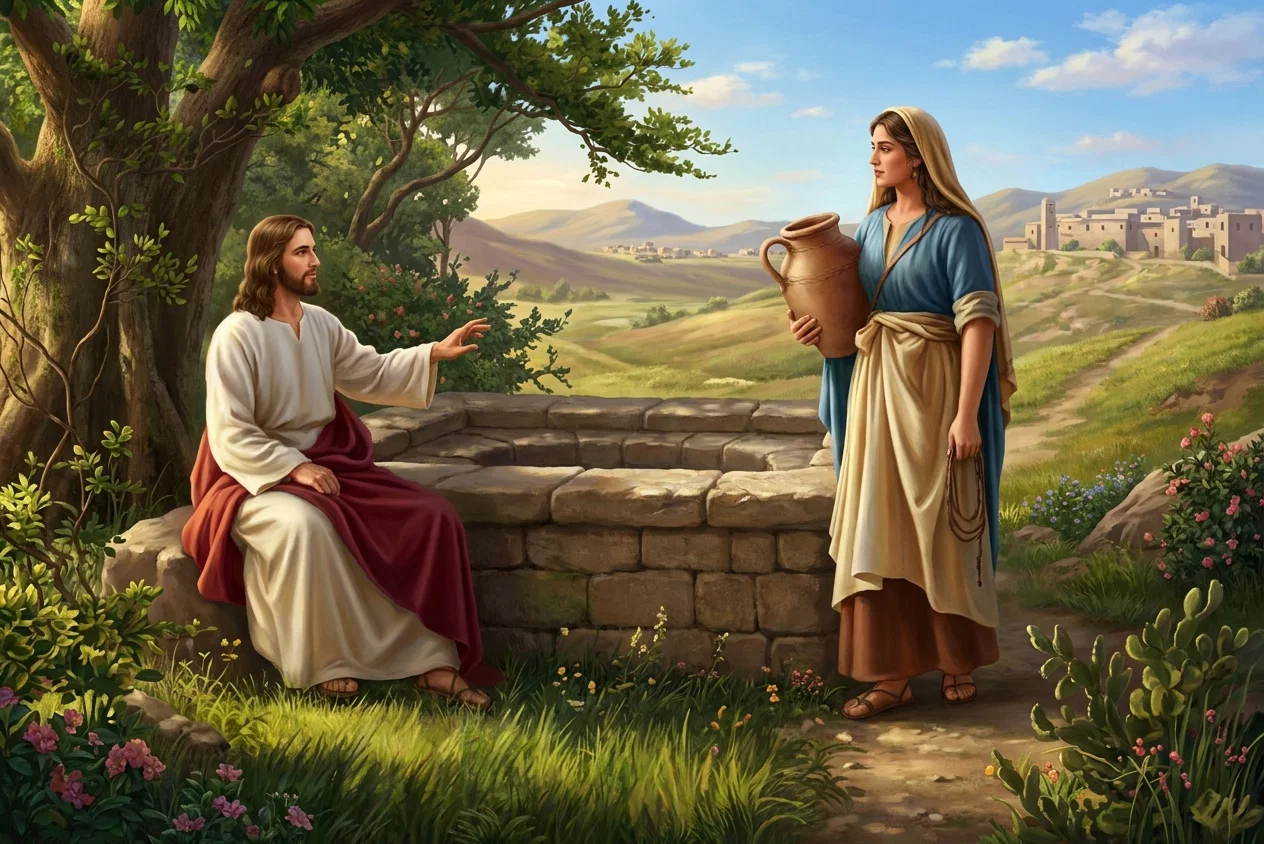
A woman of Samaria approached, and seeming unconscious of His presence, filled her pitcher with water. As she turned to go away, Jesus asked her for a drink. Such a favor no oriental would withhold. In the East, water was called “the gift of God.” To offer a drink to the thirsty traveler was held to be a duty so sacred that the Arabs184of the desert would go out of their way in order to perform it. The hatred between Jews and Samaritans prevented the woman from offering a kindness to Jesus; but the Saviour was seeking to find the key to this heart, and with the tact born of divine love, He asked, not offered, a favor. The offer of a kindness might have been rejected; but trust awakens trust. The King of heaven came to this outcast soul, asking a service at her hands. He who made the ocean, who controls the waters of the great deep, who opened the springs and channels of the earth, rested from His weariness at Jacob’s well, and was dependent upon a stranger’s kindness for even the gift of a drink of water.
The woman saw that Jesus was a Jew. In her surprise she forgot to grant His request, but tried to learn the reason for it. “How is it,” she said, “that Thou, being a Jew, askest drink of me, which am a woman of Samaria?”
Jesus answered, “If thou knewest the gift of God, and who it is that saith to thee, Give Me to drink, thou wouldst have asked of Him, and He would have given thee living water.” You wonder that I should ask of you even so small a favor as a draught of water from the well at our feet. Had you asked of Me, I would have given you to drink of the water of everlasting life.
The woman had not comprehended the words of Christ, but she felt their solemn import. Her light, bantering manner began to change. Supposing that Jesus spoke of the well before them, she said, “Sir, Thou hast nothing to draw with, and the well is deep; from whence then hast Thou that living water? Art Thou greater than our father Jacob, which gave us the well, and drank thereof himself?” She saw before her only a thirsty traveler, wayworn and dusty. In her mind she compared Him with the honored patriarch Jacob. She cherished the feeling which is so natural, that no other well could be equal to that provided by the fathers. She was looking backward to the fathers, forward to the Messiah’s coming, while the Hope of the fathers, the Messiah Himself, was beside her, and she knew Him not. How many thirsting souls are to-day close by the living fountain, yet looking far away for the wellsprings of life! “Say not in thine heart, Who shall ascend into heaven? (that is, to bring Christ down from above); or, Who shall descend into the deep? (that is, to bring up Christ again from the dead.) . . . The word is nigh thee, even in thy mouth, and in thy heart. . . . If thou shalt confess with thy mouth the Lord Jesus, and shalt believe in thine heart that God hath raised Him from the dead, thou shalt be saved.”
AT JACOB'S WELL.
“Had you asked of Me, I would have given you to drink of the water of everlasting life.”
Jesus did not immediately answer the question in regard to Himself, but with solemn earnestness He said, “Whosoever drinketh of this water shall thirst again; but whosoever drinketh of the water that I shall give him shall never thirst; but the water that I shall give him shall be in him a well of water springing up into everlasting life.”
He who seeks to quench his thirst at the fountains of this world, will drink only to thirst again. Everywhere men are unsatisfied. They long for something to supply the need of the soul. Only One can meet that want. The need of the world, “the desire of all nations,” is Christ. The divine grace which He alone can impart, is as living water, purifying, refreshing, and invigorating the soul.
Jesus did not convey the idea that merely one draught of the water of life would suffice the receiver. He who tastes of the love of Christ will continually long for more; but he seeks for nothing else. The riches, honors, and pleasures of the world do not attract him. The constant cry of his heart is, “More of Thee.” And He who reveals to the soul its necessity, is waiting to satisfy its hunger and thirst. Every human resource and dependence will fail. The cisterns will be emptied, the pools become dry; but our Redeemer is an inexhaustible fountain. We may drink, and drink again, and ever find a fresh supply. He in whom Christ dwells, has within himself the fountain of blessing,—“a well of water springing up into everlasting life.” From this source he may draw strength and grace sufficient for all his needs.
As Jesus spoke of the living water, the woman looked upon Him with wondering attention. He had aroused her interest, and awakened a desire for the gift of which He spoke. She perceived that it was not the water of Jacob’s well to which He referred; for of this she used continually, drinking, and thirsting again. “Sir,” she said, “give me this water, that I thirst not, neither come hither to draw.”
Jesus now abruptly turned the conversation. Before this soul could receive the gift He longed to bestow, she must be brought to recognize her sin and her Saviour. He “saith unto her, Go, call thy husband, and come hither.” She answered, “I have no husband.” Thus she hoped to prevent all questioning in that direction. But the Saviour continued, “Thou hast well said, I have no husband; for thou hast had five husbands; and he whom thou now hast is not thy husband: in that saidst thou truly.”
The listener trembled. A mysterious hand was turning the pages of her life history, bringing to view that which she had hoped to keep forever hidden. Who was He that could read the secrets of her life? There188came to her thoughts of eternity, of the future Judgment, when all that is now hidden shall be revealed. In its light, conscience was awakened.
She could deny nothing; but she tried to evade all mention of a subject so unwelcome. With deep reverence, she said, “Sir, I perceive that Thou art a prophet.” Then, hoping to silence conviction, she turned to points of religious controversy. If this was a prophet, surely He could give her instruction concerning these matters that had been so long disputed.
Patiently Jesus permitted her to lead the conversation whither she would. Meanwhile He watched for the opportunity of again bringing the truth home to her heart. “Our fathers worshiped in this mountain,” she said, “and ye say that in Jerusalem is the place where men ought to worship.” Just in sight was Mount Gerizim. Its temple was demolished, and only the altar remained. The place of worship had been a subject of contention between the Jews and the Samaritans. Some of the ancestors of the latter people had once belonged to Israel; but because of their sins, the Lord suffered them to be overcome by an idolatrous nation. For many generations they were intermingled with idolaters, whose religion gradually contaminated their own. It is true they held that their idols were only to remind them of the living God, the Ruler of the universe; nevertheless the people were led to reverence their graven images.
When the temple at Jerusalem was rebuilt in the days of Ezra, the Samaritans wished to join the Jews in its erection. This privilege was refused them, and a bitter animosity sprung up between the two peoples. The Samaritans built a rival temple on Mount Gerizim. Here they worshiped in accordance with the Mosaic ritual, though they did not wholly renounce idolatry. But disasters attended them, their temple was destroyed by their enemies, and they seemed to be under a curse; yet they still clung to their traditions and their forms of worship. They would not acknowledge the temple at Jerusalem as the house of God, nor admit that the religion of the Jews was superior to their own.
In answer to the woman, Jesus said, “Believe Me, the hour cometh, when ye shall neither in this mountain, nor yet at Jerusalem, worship the Father. Ye worship ye know not what: we know what we worship; for salvation is of the Jews.” Jesus had shown that He was free from Jewish prejudice against the Samaritans. Now He sought to break down the prejudice of this Samaritan against the Jews. While referring to the fact that the faith of the Samaritans was corrupted with idolatry, He declared that the great truths of redemption had been committed to189the Jews, and that from among them the Messiah was to appear. In the Sacred Writings they had a clear presentation of the character of God and the principles of His government. Jesus classed Himself with the Jews as those to whom God had given a knowledge of Himself.