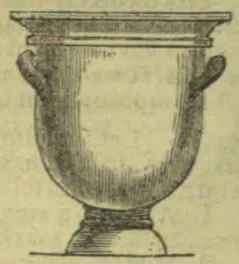
Ăc'e-tăb'û-lŭm, n.
n. [Fr. acetabule, Lat. acetabulum, a little saucer used for holding vinegar, from acetum, vinegar.]
- (Rom. Antiq.) A vessel of porcelain, silver, bronze, or gold, in the form of a goblet or teacup, in which vinegar was brought to the table; a vinegar cruse; a measure of about one eighth of a pint among the ancients. The cut is of an original, of fine red clay, in the Museum of Naples.
- (Bot.) (a.) A species of fungi, genus Peziza, so called from its cup-like shape. London. (b.) A genus of Algæ, including species having the form of a slightly concave disk on a short stem.
- (Zoöl.) (a.) The bony cup which receives the head of the thigh-bone. (b.) The cavity in which the leg of an insect is inserted at its articulation with the body. (c.) A sucker of the sepia or cuttlefish and related animals.
- One of the lobes or cotyledons of the placenta in ruminating animals.