Ăn'chor1, n.
(82), n. [Lat. anchora, ancora, Gr. ἄγκυρα, Pr. ancora, Fr. ancre, A. S. ancor, ancer, Ger., D., & Dan. anker.]
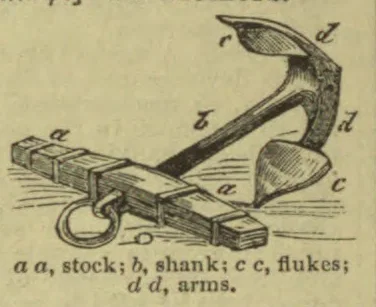
Sense 1. An iron instrument for holding a ship or other vessel at rest in water. It consists of a straight bar called a shank, having at one end a transverse bar called a stock, above which is a ring for the cable, and at the other end two or more arms with flukes forming a suitable angle with the shank to enter the ground. Brande.
a a, stock; b, shank; c c, flukes; d d, arms.
Anchors are of different sizes. The largest and strongest, and that on which most dependence is placed, is the sheet anchor. Then come the best bower, the small bower (so called from being carried on the bows), the spare anchor, the stream anchor, and the kedge anchor, which is the smallest. Totten.
Sense 2. Hence, any contrivance or instrument designed to hold fast, as an arrangement of timber to hold a dam fast; a contrivance to hold the end of a bridge-cable, or other similar part; a contrivance used by founders to hold the cone of a mold in place.
Sense 3. (Fig.) That which gives stability or security; that on which we place dependence for safety. “Which hope we have as an anchor of the soul, both sure and steadfast.” Heb. vi. 19.
Sense 4. (Arch.) Carved work, somewhat resembling an anchor:—commonly a part of the ornaments of the boultins of capitals in the Tuscan, Doric, and Ionic orders, and on the moldings of cornices.
Sense 5. (Her.) An emblem of hope.
The anchor comes home, when it is dislodged from its bed, so as to drag from the violence of the wind, sea, or current.—Foul anchor, when the anchor hooks, or is entangled with another anchor, or with a wreck or cable, or when the slack cable is entangled.—The anchor is a-cockbill, when it is suspended perpendicularly from the cat-head, ready to be let go.—The anchor is a-peak, when it is drawn in so tight as to bring the ship directly over it.—The anchor is a-trip, or a-weigh, when it is just drawn out of the ground, in a perpendicular direction, either by the cable or the buoy-rope.—To back an anchor, to lay down a small anchor ahead of that by which the ship rides, with the cable fastened to the crown of the latter to prevent its coming home.—At anchor, when a ship rides by her anchor.—To cast anchor, or to anchor, to let go an anchor to keep a ship at rest.—To weigh anchor, to heave or raise the anchor out of the ground.