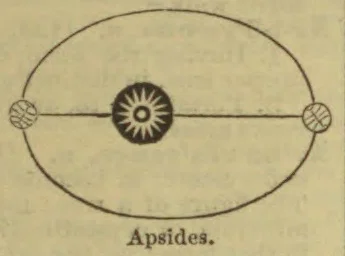
Āp'sis, n.
n.; pl. ĀP'SI-DĒS. See APSE. [Lat. apsis, absis, Gr. ἄψις, gen. ἁψῖδος, a tying, fastening, the hoop of a wheel, the wheel, a bow, arch, vault, from ἅπτειν, to fasten.]
Sense 1. (Astron.) One of the two points of an orbit, as of a planet or satellite, which are at the greatest and least distance from the central body, corresponding to the aphelion and perihelion of a planet, and to the apogee and perigee of the moon. The most distant is called the higher apsis; the other, the lower apsis, and the line joining them, the line of apsides.
Sense 2. (Arch.) (a.) The arched roof of a house, room, or oven. (b.) An inner part of a church, being a domed semicircular or polygonal termination of the choir or aisles, where the altar was placed, and where the clergy sat. (c.) The bishop’s seat or throne, in ancient churches. Gwilt.
Sense 3. A reliquary, or case in which the relics of saints were kept.