Ar·tic'ū-lā'tion, n.
n. [Fr. articulation, Lat. articulatio.]
Sense 1. (Anat.) The joining or juncture of the bones of a skeleton.
This is of three kinds: 1st, diarthrosis, or a movable connection, including enarthrosis, or the ball-and-socket joint; arthrodia, which is the same, but more superficial; ginglymus, or hinge-like joint; and trochoid, or the wheel and axle: 2d, synarthrosis, immovable connection, as by suture, or junction by serrated margins; harmony, or union by straight margins; and gomphosis, like a nail driven in a board, as the teeth in their sockets: 3d, symphysis, or union by means of another substance; as synchondrosis, union by a cartilage; syssarcosis, union by muscular fibers; synneurosis, union by tendons; syndesmosis, union by ligaments; and synostosis, union by a bony substance. Coxe.
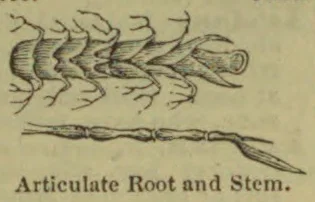
Sense 2. (Bot.) (a.) The connection of the parts of a plant by joints, as in pods. (b.) One of the nodes or joints, as in cane and maize. (c.) One of the parts intercepted between the joints; also, a subdivision into parts at regular or irregular intervals as a result of serial intermission in growth, as in the cane, grasses, &c. Lindley.
Articulate Root and Stem.
Sense 3. The utterance of the elementary sounds of a language by the appropriate movements of the organs; as, a distinct articulation.
Sense 4. A consonant; a letter representing a sound which requires a jointing or closing of the organs for its utterance.
Sense 5. The state of being jointed; distinct connection of parts. [Rare.] “That definiteness and articulation of imagery.” Coleridge.