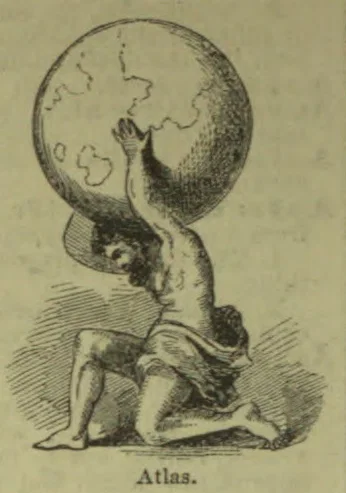
Ăt'las, n.
n.; pl. Ăt'las-es. [Lat. Atlas. See ATLANTES.]
- A collection of maps in a volume;—supposed to be so called from a picture of Atlas supporting the heavens, prefixed to some collections. This name is said to have been first used by Mercator, the celebrated geographer, in the sixteenth century.
- A volume of plates illustrating any subject.
- A work in which subjects are exhibited in a tabular form or arrangement; as, an historical or ethnographical atlas.
- A large, square folio, resembling a volume of maps;—called also atlas-folio.
- A silk-satin, manufactured in the East with admirable ingenuity. Simmonds.
- A kind of large drawing-paper. Burke.
- (Anat.) The first vertebra of the neck, articulating immediately with the occipital bone, and thus sustaining the globe of the head, whence the name.