Ax'is, n.
n.; pl. Ax'es. [Lat. axis, Gr. ἄξων, Ger. achse, A.-S. æċ.]
Sense 1. The straight line, real or imaginary, passing through a body, on which it revolves, or may be supposed to revolve.
Sense 2. (Math.) A straight line with respect to which the different parts of a magnitude are symmetrically arranged; as, the axis of a cylinder, i. e., the straight line joining the centers of the two ends; the axis of a cone, that is, the straight line joining the vertex and the center of the base; the axis of a circle, any straight line passing through the center.
Sense 3. (Bot.) (a.) The central part or column of a plant, around which the other parts are disposed, corresponding to the vertebral column in the higher orders of animals; divided into the ascending axis, or stem, and the descending axis, or root, which are united by the collet or neck. (b.) The central column in some modes of inflorescence, as in the ament, and the spike of grasses.
Sense 4. (Anat.) (a.) The second vertebra of the neck; — called also vertebra dentata. (b.) A tooth-like process, on its upper surface, which passes upward through the central foramen of the first vertebra or atlas, thus serving as a pivot on which the latter turns, whence the term.
Sense 5. (Crystallog.) An imaginary line connecting the centers of opposite faces or edges, or the apices of opposite solid angles. The axis of symmetry of a crystal is that axis about which the planes are symmetrically arranged. It is the vertical axis in the dimetric and hexagonal forms, and exists only in these. Dana.
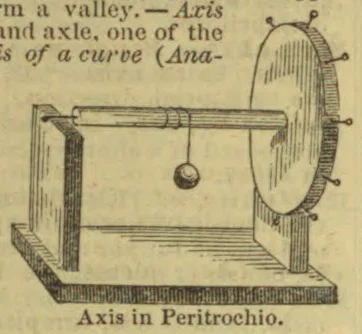
Anticlinal axis (Geol.), a line from which the strata slope downward on the two opposite sides. Synclinal axis, a line from which the strata slope upward in opposite directions, so as to form a valley. — Axis in peritrochio, the wheel and axle, one of the mechanical powers. — Axis of a curve (Analytical Geom.), a straight line which bisects a system of parallel chords of a curve, called a principal axis, when cutting them at right angles, in which case it divides the curve into two symmetrical portions, as in the parabola, which has one such axis, the ellipse, which has two, or the circle, which has an infinite number. — Axis of a lens, the straight line passing through its center and perpendicular to its surfaces. — Axis of a telescope or microscope, the straight line with which coincide the axes of the several lenses which compose it. — Axes of co-ordinates in a plane, straight lines intersecting each other, to which points are referred for the purpose of determining their relative position: they are either rectangular or oblique. Axes of co-ordinates in space, the straight lines in which the co-ordinate planes intersect each other. — Axis of a balance, that line about which it turns. — Axis of oscillation, of a pendulum, a right line passing through the center about which it vibrates, and perpendicular to the plane of vibration. — Axis of polarization, the central line around which the prismatic rings or curves are arranged. Brewster. — Axis of revolution (Descriptive Geom.), a straight line about which some line or plane is revolved, so that the several points of the line or plane shall describe circles with their centers in the fixed line, and their planes perpendicular to it. — Axis of symmetry (Elementary Geom.), any line in a regular polygon bisecting an angle, or bisecting, and perpendicular to, a side. — Axis of the equator, ecliptic, horizon, or other circle considered with reference to the sphere on which it lies, the diameter of the sphere which is perpendicular to the plane of the circle. Hutton. — Axis of the Ionic capital, a line passing perpendicularly through the middle of the eye of the volute. — Neutral axis (Mech.), the part of a girder which is neither in compression nor tension. — Optic or visual axis (Opt.), the straight line passing through the center of the pupil, and perpendicular to the surface of the eye. — Spiral axis (Arch.), the axis of a twisted column drawn spirally in order to trace the circumvolutions without.