Azī-mūth, n.
[Ar. as-samt, pl. as-sumut, a way or path; samt al-ras, the vertex of the heaven; hence zenith, a corruption of zemt, or semt, and al-samt, a point of the horizon, and a circle extending to it from the zenith, commonly called azimuth.] (Astron. & Geodesy.) An arc of the horizon intercepted between the meridian of the place and a vertical circle passing through the center of any object; as, the azimuth of a star; the azimuth or bearing of a line in surveying. Hutton.
In trigonometrical surveying, it is customary to reckon the azimuth of a line from the south point of the horizon around by the west from 0° to 360°.
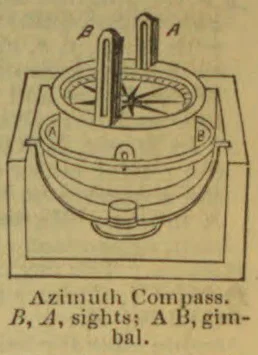
Azimuth circles, or vertical circles, great circles of the sphere intersecting each other in the zenith and nadir, and cutting the horizon at right angles. Hutton.—Azimuth compass, a compass resembling the mariner’s compass, but with a more accurate graduation of the card, and vertical sights; used for taking the magnetic azimuth of a heavenly body, in order to find, by comparison with the true azimuth, the variation of the needle. Azimuth Compass. B, A, sights; A B, gimbal.—Azimuth dial, a dial whose stile or gnomon is at right angles to the plane of the horizon. Hutton.—Magnetical azimuth, an arc of the horizon, intercepted between the azimuth or vertical circle passing through any object and the magnetic meridian. This is found by observing the object with an azimuth compass.