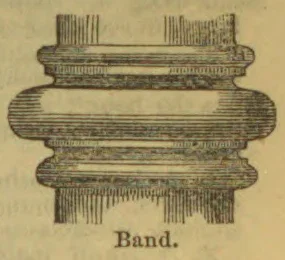
Bänd1, n.
n. [A-S. banda, from bindan, to bind; Ger., Sw., & D. band, O. H. Ger. bant, Goth. bandi; Fr. bande, band. See BIND.]
Sense 1. Any narrow ligament with which a thing is encircled, or fastened, or by which a number of things are confined together; a fillet; a cord. “Bound with leaden bands.” Bacon.
Sense 2. (Arch.) (a.) Any flat, low member or molding, broad, but not deep;—called also fascia, face, or plinth. (b.) Any continuous tablet or series of ornaments, &c., in a wall or on a building; as, a band of foliage, of bricks, &c. (c.) In Gothic architecture, the molding, or suit of moldings, which encircles the pillars and small shafts.
Sense 3. Means of union or connection between persons. “To join in Hymen’s bands.” Shak.
Sense 4. (Eccl.) A linen ornament worn about the neck by clergymen. Addison.
Sense 5. A company of persons united in any common design, especially a body of armed men.
Troops of horsemen, with his bands of foot. Shak.
Sense 6. (Bot.) A space between elevated lines or ribs, as of the fruits of umbelliferous plants. London.
Sense 7. (Mech.) A belt passing over two pulleys, and communicating motion from one to the other. [See Illust. of Pulley.]
Sense 8. A bond. [Obs.]
Tell me, was he arrested on a band? Not on a band, but on a stronger thing. Shak.