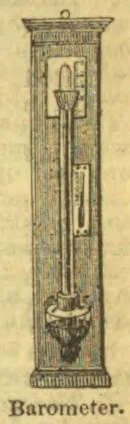
Ba-rōm'e-ter, n.
n. [Fr. baromètre, N. Lat. barometrum, from Gr. βάρος, weight, and μέτρον, measure.] An instrument for determining the weight or pressure of the atmosphere, and hence the actual and probable changes of weather, or height of any ascent.
The form commonly used, was invented by Torricelli at Florence in 1643. It consists of a glass tube, 33 or 34 inches in length, closed at top, filled with mercury, except the vacuum at the top, and inverted in an open cup of mercury. A graduated scale is attached to the tube, to note the variations of the column of mercury. The aneroid barometer is a form of the instrument in which the atmosphere acts upon the elastic top of a thin metallic box, which has previously been partially exhausted of air; and furnished with levers and an index to note the changes produced by atmospheric pressure. The siphon barometer is another form of the common one. The sympiesometer is another form. See SYMPIESOMETER. Nichol.
Marine barometer, a barometer with tube contracted at bottom to prevent rapid oscillations of the mercury, and suspended in gimbals from an arm or support on shipboard. — Mountain barometer, a portable mercurial barometer with tripod support, and long scale, for measuring heights. — Wheel barometer, a barometer with recurved tube, and a float, from which a cord, by passing over a pulley, moves an index.