Bāy'o-net1, n.
n. [Fr. bayonnette, baïonnette, Sp. bayoneta, It. bajonetta;—so called, it is said, because the first bayonets were made at Bayonne, in the year 1640. Cf. O. Fr. bayonnier, a cross-bowman.]
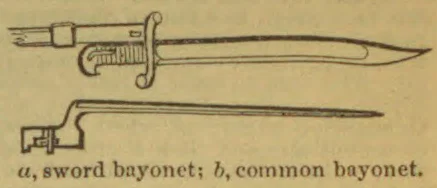
Sense 1. (Mil.) A short, pointed instrument of iron, or broad dagger, formerly with a handle fitted to the bore of a gun, where it was inserted for use after the soldier had fired; but now made with a ring, to go over the muzzle of the piece, so that the soldier may fire with his bayonet fixed.
a, sword bayonet; b, common bayonet.
Sense 2. (Mach.) A pin which plays in and out of holes made to receive it, and which thus serves to engage or disengage parts of the machinery. Nicholson.