5 entries under this word

Bear

Beâr, v. t.

verbtransitive

(bâr), v. t. [imp. BORE (formerly BARE); p. p. BORN, BORNE; p. pr. & vb. n. BEARING.] [A-S. beran, beoran, geberan, to bear, carry, produce, aberan, to sustain, O. S. beran, giberan, Goth. bairan, to bear or carry, gabairan, to bear, bring forth, Icel. bera, O. H. Ger. beran, peran, Sw. bära, Dan. bäre; Ger. gebären, to bring forth, D. beuren, to lift, baren, to bring forth, Lat. ferre, to bear, carry, produce, Gr. φέρειν, Skr. bhri, to bear, Slav. brati, to take, carry.]

  1. To support or sustain; to hold up.
  2. To support and remove or carry; to convey.

Solomon had threescore and ten thousand that bare burdens. 1 Kings v. 15. I'll bear your logs the while. Shak.

  1. To possess and use, as power; to exercise; as, to bear sway.
  2. To possess or carry, as a mark of authority or distinction; to wear; as, to bear a sword, badge, or name; to bear arms in a coat.
  3. To possess mentally; to carry in the mind; to entertain; to cherish.

The coward bore the man immortal spite. Dryden. 6. To endure; to tolerate; to undergo; to suffer. Should such a man, too fond to rule alone, Bear, like the Turk, no brother near the throne. Pope. 7. To gain or win. [Obs.] Some think to bear it by speaking a great word. Bacon. She was . . . found not guilty, through bearing of friends and bribing of the judge. Latimer. 8. To sustain, or be answerable for, as blame, expense, and the like. Somewhat that will bear your charges. Dryden. 9. To show or exhibit; to relate; to bring forward. “Your testimony bear.” Dryden. 10. To carry on, or maintain; to have. “The credit of bearing a part in the conversation.” Locke. 11. To admit or be capable of; that is, to suffer or sustain without violence, injury, or change. In all criminal cases the most favorable interpretation should be put on words that they can possibly bear. Swift. 12. To behave; to conduct. “Hath he borne himself penitently.” Shak. 13. To afford; to be to; to supply with. His faithful dog shall bear him company. Pope. 14. To bring forth or produce; to give birth to; as, to bear apples; to bear children. Here dwelt the man divine whom Samos bore. Dryden. ☞ In the passive form of this verb, the best modern usage restricts the past participle born to the sense of brought forth, while borne is used in the other senses of the word. In the active form, borne alone is used as the past participle. To bear a hand (Naut.), to go to work; to assist. — To bear a body. A color is said to bear a body in painting when it is capable of being ground so fine, and mixed so entirely with the oil, as to seem only a very thick oil of the same color. Johnson. — To bear a brain, to exert attention, ingenuity, or memory. [Obs.] Shak. — To bear in hand, to amuse with false pretenses; to deceive. [Obs.] — To bear the bell. See BELL. — To bear down, to overthrow or crush by force; as, to bear down an enemy. — To bear hard, to press or urge. “Cesar doth bear me hard.” Shak. — To bear off. (a.) To restrain; to keep from reproach. (b.) (Naut.) To remove to a distance; to keep clear from rubbing against any thing; as, to bear off a blow; to bear off a boat. — To bear out, to maintain and support to the end; to defend to the last. “Company only can bear a man out in an ill thing.” South. — To bear through, to conduct or manage; as, to bear through the consulship. B. Jon. — To bear up, to support; to keep from falling or sinking. “Religious hope bears up the mind under sufferings.” Addison. — To bear date, to be dated.
Beâr, v. i.

verbintransitive

(bâr), v. i.

Sense 1. To suffer, as with pain. [Rare.] But man is born to bear. Pope.

Sense 2. To endure with patience; to be patient. [Rare.] I can not, can not bear. Dryden.

Sense 3. To produce, as fruit; to be fruitful, in opposition to barrenness. This age to blossom, and the next to bear. Dryden.

Sense 4. To press; — with on or upon. These men bear hard on the suspected party. Addison.

Sense 5. To take effect; to succeed; as, to bring matters to bear.

Sense 6. To act in any character; to behave. [Obs.] Instruct me how I may bear like a true friar. Shak.

Sense 7. To be situated, as to the point of compass, with respect to something else; as, the land bears N. by E.

Sense 8. To relate or refer; — with on or upon; as, how does this bear on the question?

Sense 9. To convey intelligence. [Rare.] “The letters bore that succor was at hand.” W. Scott.

To bear away, or up (Naut.), to change the course of a ship, when close hauled, or sailing with a side wind, and make her run before the wind. — To bear against, to approach for attack or seizure; as, a lion bears against his prey. — To bear back, to retreat. “Bearing back from the blows of their sable antagonist.” W. Scott. — To bear down upon (Naut.), to drive or tend to; to approach with a fair wind; as, the fleet bore down upon the enemy. — To bear in with (Naut.), to run or tend toward; as, a ship bears in with the land. — To bear off (Naut.), to steer away from land. — To bear up, to be supported; to have fortitude; to be firm; not to sink; as, to bear up under afflictions. — To bear upon, or against, to lean upon or against. — To bear upon, to act upon; as, the artillery bore upon the center; or to be pointed or situated so as to affect; as, to bring or plant guns so as to bear upon a fort or a ship. — To bear up to, to tend or move toward; as, to bear up to one another. — To bear with, to endure; to be indulgent to; to forbear to resent, oppose, or punish.

Bēar, n.

noun

n. A bier. [Obs.] Spenser.

Beār, n.

noun

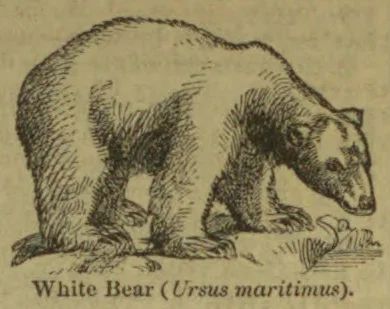
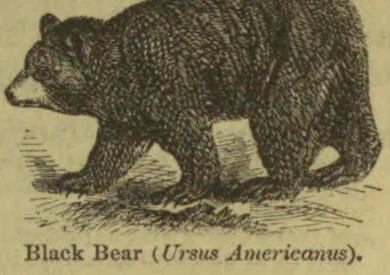
n. [A-S. bera, D. beer, O. H. Ger. bero, pero, M. H. Ger. ber, N. H. Ger. bär, Icel., Sw., & Dan. biörn.] 1. (Zoöl.) A wild plantigrade quadruped of the genus Ursus. It belongs to the carnivorous order, but lives mostly on plants and fruits. Among the species are the brown bear of Europe (Ursus arctos), the white polar bear (U. maritimus), the grisly bear of the Rocky Mountains (U. horribilis), the black bear of North America (U. Americanus); besides which there are several species, some of them fossil, as the U. spelaeus of Europe, which exceeded in size any living species. 2. (Astron.) One of two constellations in the northern hemisphere, called respectively the Greater and Lesser Bear, or Ursa Major and Ursa Minor. Bears and bulls, in cant language, persons engaged in the gambling transactions of the stock exchange. A bear is one who contracts to deliver, at a specified future time, stocks which he does not own; a bull is one who contracts to take them. Hence, in the intervening time, it is the interest of the former to depress stocks, as the bear pulls down with his strong paws, and of the latter to raise stocks, as the bull throws upward with his horns. The stock is, in fact, never delivered, and was never meant to be. When the time for delivery arrives, the losing party pays the difference between the price of the stock then and at the time when the contract was made.

A white bear walks across rocky ground.
White Bear (*Ursus maritimus).
A black bear is shown walking through grass.
Black Bear (*Ursus Americanus).

Bēar or Bēre, n.

noun

n. [A-S. bere. See BARLEY.] (Bot.) A species of barley (Hordeum hexastichon) having six rows in the ear, cultivated in Scotland and the north of England;—called also big. London.

Also printed under this word