Bea'ver1, n.
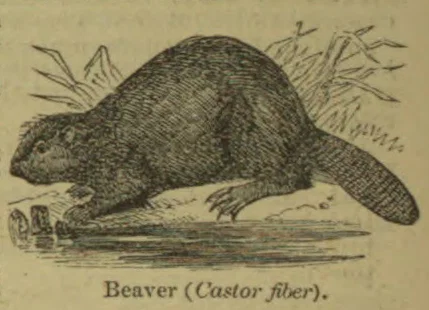
(bē'ver), n. [O. Eng. bever, A-S. beofer, befer, beber, Icel. bifr, bior, biur, Sw. bäfver, Dan. bäver, D. bever, O. H. Ger. bibar, pipur, pipir, pipur, N. H. Ger. biber, Lith. behru, Russ. bobr', Gael. beabhr, Corn. befer, Lat. fiber, Fr. bièvre, N. Pr. vibre, Sp. bíbaro, bevaro, befre, It. bivaro, bevero.] 1. (Zool.) An amphibious, rodent quadruped, of the genus Castor. See MAMMALS. It differs from other rodents especially by its palmated hind feet, and broad, flat, trowel-like tail, both characteristics fitting it for its burrowing and building habits. It is remarkable for its ingenuity in constructing its lodges or habitations. It is valued for its fur, and for the material called castor, obtained from two small bags in the groin of the animal. Its fur, which is mostly of a chestnut-brown, is the material of the best hats. The European species is the Castor fiber, and the American is generally considered as a variety of this, although sometimes named the Castor Americanus, or C. Canadensis. Beaver (Castor fiber).
- The fur of the beaver.
- A hat made of the fur of the beaver. “A brown beaver slouched over his eyes.” Prescott.
- A cloth, sometimes felted, used for making overcoats, hats, &c. Simmonds.