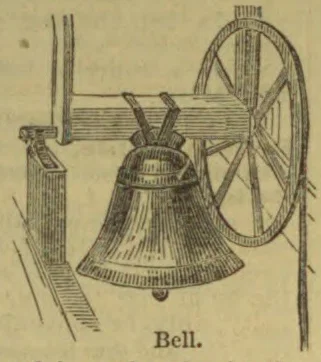
Bell1, n.
n. [O. Eng. & A-S. belle, L. Ger. belle, D. bel; A-S. bellan, to bellow, to make a loud noise; Ger. bellen, to bark. See BAWL.]
Sense 1. A hollow metallic vessel which gives forth a clear, musical, ringing sound on being struck.
In its most common form, it is expanded at the lower part, is furnished at the top with an ear for the purpose of suspension, and has within it a tongue or clapper, by the blow of which the sound is produced. Another form, especially of small bells, is that of a hollow body of metal perforated, and containing a loose solid ball, to make a sound when it is shaken.
Sense 2. Any thing in the form of a bell, as the cup or corol of a flower. “In a cowslip’s bell I lie.” Shak.
Sense 3. (Arch.) The naked vase or corbel of Corinthian or composite capitals, round which the foliage and volutes are arranged;—called also drum. Gavit.
To bear away the bell, to win the prize at a race where the prize was a bell; hence, to be superior in something. Fuller.—To bear the bell, to be the first or leader, in allusion to the bell-wether of a flock, or the leading horse of a team or drove that wears bells on his collar.—To curse by bell, book, and candle, a solemn form of excommunication used in the Roman Catholic church, the bell being tolled, the book of offices for the purpose being used, and three candles being extinguished with certain ceremonies. Nares.—To lose the bell, to be worsted. “In single fight he lost the bell.” Fairfax.—To shake the bells, to move, give notice, or alarm. Shak.—To bell the cat, to put a bell on, to encounter and cripple one of a greatly superior force;—a phrase derived from the fable of the mice resolving to put a bell on the cat, to guard them against his attack. W. Scott.