Boil'er, n.
n. 1. One who boils.
- A vessel in which any thing is boiled.
- (Mech.) A strong metallic vessel, usually of wrought iron plates riveted together, in which steam is generated for driving engines, or other purposes.
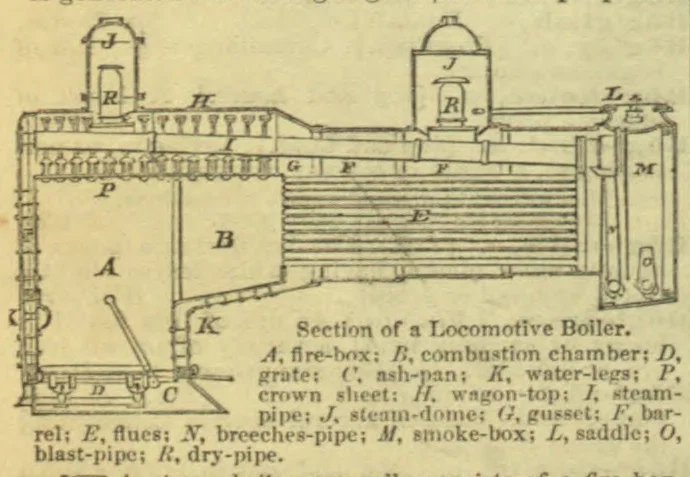
Section of a Locomotive Boiler. A, fire-box; B, combustion chamber; D, grate; C, ash-pan; K, water-legs; P, crown sheet; H, wagon-top; I, steam-pipe; J, steam-dome; G, gusset; F, barrel; E, flues; N, breeches-pipe; M, smoke-box; L, saddle; O, blast-pipe; R, dry-pipe.
A steam boiler generally consists of a fire-box, where the combustion of fuel occurs, and flues, through which the products of combustion pass into the chimney. These parts are made of thin metal, and surrounded by water, which, together with the steam room, is contained in an outer shell. The principal varieties are, the cylinder boiler, which consists of a single iron shell; the return-flue and the drop-flue boilers, called flue boilers, which are single shells containing a small number of large flues, through which the heat either passes from the fire or returns to the chimney, and sometimes containing a fire-box inclosed by water; the multiflue or locomotive boiler, which consists of an inclosed fire-box and a large number of small flues leading to the chimney; and the water-tube boiler, which consists of an inclosed fire-box and a fire-chamber filled with small tubes, through which the water circulates. See TUBE and FLUE.
Tubular boiler, a multiflue or multitubular boiler, in distinction from a boiler with large flues.