5 entries under this word

Bolt

Bōlt, n.

noun

(20), n. [A-S. & Dan. bolt, Icel. bolti, O. H. Ger. bolz, polz, M. & N. H. Ger. bolz, D. bout, W. bolt, It. bolzone, bolcione, a battering-ram, catapult, like A-S. bolt. Cf. BOLIS.]

Sense 1. A pointed shaft or missile intended to be shot from a cross-bow or catapult; an arrow; a dart. “A fool’s bolt is soon shot.” Shak.

Sense 2. A strong pin, of iron or other material, used to fasten or hold something in place, as a door, a chain, the planks of a ship, &c.

And every bolt and bar Of massy iron or solid rock with ease Unfastens. Milton.

Sense 3. A thunder-bolt; a stream of lightning.

Sense 4. An iron to fasten the legs of a prisoner; a shackle.

Away with him to prison, lay bolts enough upon him. Shak.

Sense 5. The quantity of twenty-eight ells of canvas.

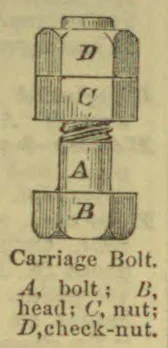
Bolt and nut, a metallic pin with a head formed upon one end, and a movable piece (the nut) screwed upon a thread cut upon the other end. See Bolt and Nut. TAP-BOLT and SCREW-BOLT.
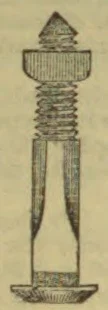
A vertical screw mechanism with a broad head, a threaded shaft, and a long forked lower section attached to a base.
A carriage bolt is shown with its bolt, head, nut, and check-nut labeled.
Carriage Bolt.

Bōlt, v. t.

verbtransitive

Sense 1. To fasten or secure with a bolt or pin, as a door, a plank, fetters, &c.

Let tenfold iron bolt my door. Langhorn.

Sense 2. To fasten; to shackle; to restrain.

Which shackles accident and bolts up change. Shak.

Sense 3. To throw precipitately; to blurt out; to utter or throw out.

I hate when Vice can bolt her arguments. Milton.

Sense 4. To swallow without chewing; as, to bolt food.

Bōlt, v. t.

verbtransitive

v. t. [imp. & p. p. BOLTED; p. pr. & vb. n. BOLTING.] [O. Fr. bulter, buleter, bluter, L. Lat. buletare, M. H. Ger. butein, N. H. Ger. beuteln, to bolt, sift; Fr. bluteau, blutoir, L. Lat. buletellum, buletellus, buttellus, Ger. beutel, a bolter, bolt-bag. Cf. BULTEL.]

Sense 1. To sift or separate the coarser from the finer particles of, as bran from flour, by means of a bolter; to separate, assort, or purify by other means; as, to bolt meal.

He now had bolted all the flour. Spenser.

The fanned snow That's bolted by the northern blast twice o'er. Shak.

Sense 2. To examine as by sifting; to open or separate the parts of, in order to find the truth;—generally followed by out. “Time and nature will bolt out the truth of things.” L’Estrange.

Sense 3. (Law.) To discuss or argue privately, and for practice, as cases. Jacobs.

Sense 4. (Sporting.) To start or cause to spring forth; to dislodge, as conies, rabbits, &c.

To bolt to the bran, to examine thoroughly, so as to separate or discover every thing important.

This bolts the matter fairly to the bran. Harte.

The report of the committee was examined and sifted and bolted to the bran. Burke.

Bōlt, v. i.

verbintransitive

v. i. 1. To start forth like a bolt; hence, to spring or move abruptly; as, to bolt out of the room. This Puck seems but a dreaming dolt, . . And oft out of a bush doth bolt. Drayton. 2. To strike or fall suddenly like a bolt. His cloudless thunder bolted on their heads. Milton.

  1. To spring suddenly aside, or out of the regular path; as, the horse bolted.
  2. To desert or quit suddenly, as a party or organization. [U. S.]

Bōlt, adv.

adverb

With sudden meeting or collision. “[He] came bolt up against the heavy dragoon.” Thackeray.