Bŏnd1, n.
n. [A-S. bond, bound, for bunden, p. p. of bindan, to bind. Cf. BAND and BIND.]
Sense 1. That which binds; that which fastens or confines, or by which any thing is fastened or confined, as a cord, chain, &c.; a band; a ligament.
Gnawing with my teeth my bonds in sunder, I gained my freedom. Shak.
Sense 2. (pl.) The state of being bound; imprisonment; captivity.
This man doeth nothing worthy of death or of bonds. Acts. xxvi. 31.
Sense 3. A binding force or influence; a cause of union; a uniting tie; as, the bonds of fellowship.
I have struggled through much discouragement . . . for a people with whom I have no tie but the common bond of mankind. Burke.
Sense 4. An obligation imposing a moral duty, as by a vow, or promise by law, or other means.
I love your majesty According to my bond, nor more nor less. Shak.
Sense 5. (Law.) A writing under seal by which a person binds himself, his heirs, executors, and administrators, to pay a certain sum on or before a future day appointed. This is a single bond. But usually a condition is added, that, if the obligor shall do a certain act, or pay a certain sum of money, on or before a time specified, the obligation shall be void; otherwise it shall remain in full force. If the condition is not performed, the bond becomes forfeited, and the obligor and his heirs are liable to the payment of the whole sum. Bouvier. Wharton.
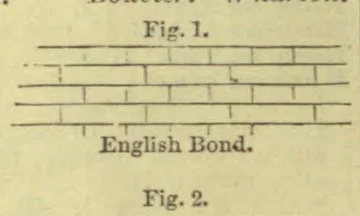
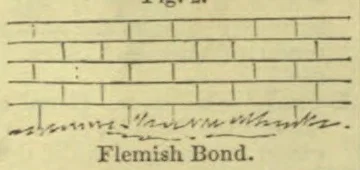
Sense 6. (Arch.) The union or tie of the several stones or bricks forming a wall. The bricks may be arranged for this purpose in several different ways, as in English or block bond (Fig. 1), where one course consists of bricks with their ends toward the face of the wall, called headers, and the next course of bricks with their lengths parallel to the face of the wall, called stretchers; Flemish bond (Fig. 2), where each course consists of headers and stretchers alternately, so laid as always to break joints; Cross bond, which differs from the English by the change of the second stretcher-line so that its joints come in the middle of the first, and the same position of stretchers comes back every fifth line; Combined cross and English bond, where the inner part of the wall is laid in the one method, the outer in the other. Appleton.
Bond timbers, timbers placed in the walls of a building to tie them longitudinally, called sometimes chain bond. The term bonds, in the plural, is often used to signify not only these, but other timbers disposed in the wall of a house, as wall plates and lintels. Gwilt.
Synonyms—Chains; fetters; captivity; imprisonment.