n. [L. Ger. brake, an instrument for breaking flax, H. Ger. breche, id., from the root of break, Ger. brechen.]
1Sense 1. An instrument or machine to break flax or hemp.
2Sense 2. The handle by which a pump is worked.
3Sense 3. A baker’s kneading-trough. Johnson.
4Sense 4. A sharp bit or snaffle. “Pampered jades . . . which need nor brake nor bit.” Gascoigne.
5Sense 5. A contrivance for confining refractory horses while the smith is shoeing them; also, an inclosure to restrain cattle, horses, &c.
A passing fair horse . . . which Philip had bought . . . and because of his fierceness kept him within a brake of iron bars. Brende.
6Sense 6. (Mil.) (a.) That part of the carriage of a movable battery, or engine, which enables it to turn. (b.) An ancient engine of war analogous to the cross-bow and ballista.
7Sense 7. (Agric.) A large, heavy harrow for breaking clods after plowing.
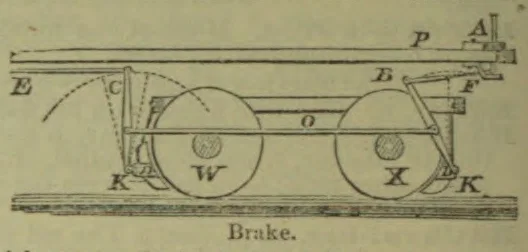
8Sense 8. A piece of mechanism for retarding or stopping motion by friction, as of a carriage or railway car, by the pressure of rubbers against the wheels.
The cut shows the brake generally used in America, and known as “The Stevens Brake.” The hand-wheel on the spindle A, which is fastened to the platform P of the car, winds up the chain F, and pulls the lever B, which presses the brake-block K upon the wheel X, and pulls the rod O, which presses the brake-block upon the wheel W, and pulls the rod E, which runs to the other truck, where there is a duplicate of the arrangement shown. Thus, turning the brake-wheel at either end of the car brings an equal pressure upon all the wheels.
Brake.
9Sense 9. A cart or carriage without a body, used in breaking in horses.
10Sense 10. An ancient instrument of torture. Holinshed. Brake-beam, or brake-bar, the part that connects the brake-blocks of opposite wheels.—Brake-block (a.), the part of a brake holding the brake-shoe; (b.), a brake-shoe.—Brake-shoe, or brake-rubber, the part of a brake against which the wheel rubs.—Brake-wheel, the hand-wheel by which power is applied to a brake.