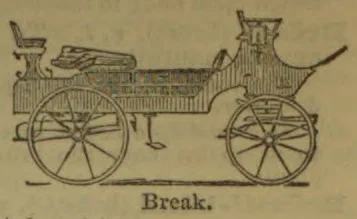
Breāk1, v. t.
v.t. [imp. BROKE (BRAKE, obs.); p.p. BROKE or BROKEN; p.pr. & vb.n. BREAKING.] [A-S. & O. Sax. brecan, D. breken, Goth. brikan, O. H Ger. brechan, N. H. Ger. brechen, Icel. brâka, Sw. bräcka, Dan. bräkke; allied to Lat. frangere, for fragere, Skr. bhandj, in which the letter r has been dropped, Gr. ῥηγνύναι, where the initial consonant has been omitted. Cf. BRAY.]
Sense 1. (a.) To strain apart; to sever by fracture; to divide with violence; as, to break a rope or chain; to break a seal; to break an axle. “Shall break the locks of prison gates.” Shak. Hence, to lay open by breaking; as, to break a package of goods. And (Fig.) to lay open, as a purpose; to disclose, divulge, or communicate. “Katharine, break thy mind to me.” Shak. (b.) To infringe or violate, as an obligation, law, or promise.
Out, out, hyena! these are thy wonted arts . . . To break all faith, all vows, deceive, betray. Milton.
(c.) To interrupt; to destroy the continuity of; to dissolve or terminate.
Break not your sleeps for that. Shak.
Go, release them, Ariel; My charms I’ll break, their senses I’ll restore. Shak.
Him who disobeys, Me disobeys, breaks union. Milton.
(d.) To destroy the completeness of; to remove a part from; as, to break a set.
Sense 2. To dash or shatter to pieces; to reduce to fragments.
The victim broke in pieces the musical instruments with which he had solaced the hours of captivity. Prescott.
Sense 3. Hence, (a.) To shatter or crush, without separation of parts; to destroy the strength, firmness, or consistency of; to bruise; as, to break flax. “I saw him break Skogan’s head.” Shak. (b.) To weaken, impair, or subdue, as health or the faculties. “An old man, broken with the storms of state.” Shak. (c.) To diminish the force of; to lessen the shock of, as a fall or blow. “I’ll rather leap down first, and break your fall.” Dryden. And (Fig.) to impart cautiously, so as to avoid shocking or exciting opposition. Bacon. (d.) To tame; to reduce to subjection; to make tractable; to discipline. “To break a colt.” Spenser. “Why then thou canst not break her to the lute.” Shak. “That golden scepter, which thou didst reject, is now an iron rod, to bruise and break thy disobedience.” Milton. (e.) To destroy the financial credit of; to make bankrupt. “With arts like these rich Matho, when he speaks, Attracts all fees, and little lawyers breaks.” Dryden. (f.) To destroy the official character and standing of; to cashier. “I see a great officer broken.” Swift.
With prepositions or adverbs.
To break across (Tilting), to suffer the spear to be turned out of its direction, and be fractured across the body of the opponent, instead of by the thrust with the point. Nares.—To break down, to crush; to overwhelm.—To break in, to force in; as, to break in a door. Also, to train; to discipline; as, a horse well broken in.—To break of, to rid of; to cause to reform, or abandon; as, to break one of a habit.—To break off, to separate by breaking; as, to break off a twig; to interrupt; to put an end to. “Break off thy sins by righteousness.” Dan. iv. 27.—To break open, to open by breaking. “Open the door, or I will break it open.” Shak.—To break out, to take or force out by breaking; as, to break out a pane of glass.—To break over, to transgress; to overleap; to disregard; as, to break over a rule.—To break up, to separate into parts; to dissolve; to put an end to. “Break up this capon.” Shak. “Break up your fallow ground.” Jer. iv. 3. “Break up the court.” Shak.
With an object.
To break the back, neck, &c., to dislocate the joints of; to disable.—To break bulk, to destroy the entirety of a load by removing a portion of it; to begin to unload; also, to transfer in detail, as from boats to cars.—To break cover, to burst forth from a protecting concealment, as game when hunted.—To break fast, to partake of food after abstinence, especially in the morning. See BREAKFAST.—To break ground, to open the earth as for planting; to commence excavation, as for building, siege operations, and the like; as, to break ground for a foundation, a canal, or railroad. Hence (Fig.), to begin to execute any plan; (Naut.), to release the anchor from the bottom. Totten.—To break the heart, to crush or overwhelm with grief.—To break a house (Law), to remove any part of the house or of the fastenings provided to secure it, with violence and a felonious intent. Bouvier.—To break the ice, to get through first difficulties; to overcome obstacles and make a beginning.—To break jail, to escape from confinement in jail, usually by forcible means.—To break a jest, to utter a jest. “Patroclus . . . the livelong day breaks scurril jests.” Shak.—To break joints, to lay bricks, shingles, &c., so that the joints in one course shall not coincide with those in the preceding course.—To break a path, road, or the like; to open a way through obstacles by force.—To break sheer (Naut.), to be forced by wind or current out of a position; to sheer clear of her anchor;—said of a vessel when she is at anchor. Totten.—To break upon a wheel, to execute or torture, as a criminal by stretching him out upon a cart-wheel or wooden frame in form of a St. Andrew’s cross, and breaking his limbs with an iron bar;—a mode of punishment formerly used in Germany and France.—To break wind, to give vent to wind from the anus.
Synonyms—To dispart; rend; tear; crash; shatter; batter; violate; infringe; demolish; destroy.