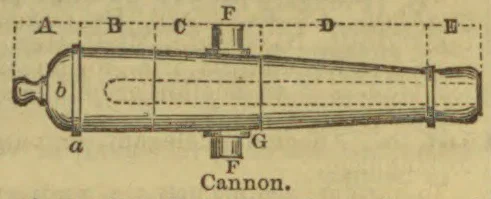
Căn'non, n.
n. [Fr. canon, It. cannone, Sp. cañon, Pg. canhão, D. kanon, Ger. kanone; Pr. canon, pipe; from Lat. canna, reed, pipe, tube. See CANE and CAN.]
Sense 1. A military engine, of which the general form is that of a hollow cylinder closed at one end, and variously mounted, used for throwing balls and other instruments of death by the force of gunpowder.
Cannons are made of iron, brass, bronze, and sometimes of steel rods welded together, and are of different sizes, carrying balls from one pound in weight to that of three hundred pounds or more. They are classified, from their nature, as guns, howitzers, and mortars; also, from their use, as field, mountain, prairie, sea-coast, and siege; also, as rifled and smooth-bore.
Sense 2. (Mech.) A hollow cylindrical piece through which a revolving shaft passes, on which it is carried, and on which it may revolve independently, with a greater or less velocity than that of the shaft; as the prolongation of the eye of a wheel.
Sense 3. (Typog.) A kind of type. See CANON.
Sense 4. A particular stroke in the game of billiards. See CARROM. Thackeray.