2 entries under this word

Capital

Căp'i-tal, a.

adjective

a. [Lat. capitalis, from caput, head.]

  1. Pertaining to, or on, the head. [Obs.] “A capital bruise.” Milton.
  2. Having reference to, or involving, the forfeiture of the head or life; affecting life; as, capital trials; capital punishment. “Many crimes that are capital among us.” Swift.

He whose conscience thinks it sin to put to death a capital offender, will as oft think it meritorious to kill a righteous person. Milton. 3. First in importance; chief; principal; excellent; as, a capital city; a capital speech. “A capital article in religion.” Atterbury. It is now that whatever is capital and essential in Christianity should be clearly and strenuously affirmed. J. Taylor.
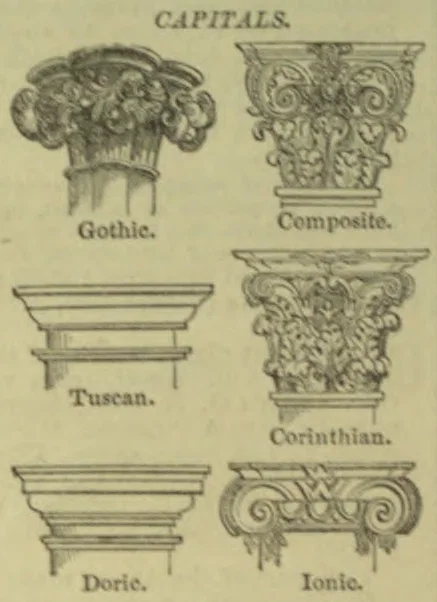
Căp'i-tal, n.

noun

n. [Cf. Lat. capitellum and capitulum, a small head, the head, top, or capital of a column, dim. of caput, head; Fr. chapiteau, O. Fr. & Pr. capitel.]

Sense 1. (Arch.) The head or uppermost part of a column, pilaster, &c.

In classical architecture, the orders have each their respective capitals. Goth. Gloss.

Sense 2. [Fr. capitale, f., sc. ville.] (Geog.) The chief city or town in a country; a metropolis. “A busy and splendid capital.” Macaulay.

Sense 3. [Fr. capital.] A stock employed in trade, manufactures, &c.

With respect to a nation, the destruction of its productive capital is impossible. Bentham.

Sense 4. Means of increasing one's power; influence; as, political capital.

Sense 5. [Fr. lettre capitale.] (Print.) A letter distinguished by its form or greater size from those ordinarily used in the body of the page; a capital letter.

Sense 6. (Fort.) The line which bisects the salient angle of a raveline. See RAVELIN.

Sense 7. A chapter, or section, of a book. [Obs.] “Holy St. Bernard hath said in the 50th capital.” W. Scott.

The illustration shows six architectural column capitals in the Gothic, Composite, Tuscan, Corinthian, Doric, and Ionic styles.
CAPITALS.