Cāse'māte, n.
n. [Fr. casemate, Sp. & Pg. casamata, It. casamatta, from casa, house, and matto, f. matta, mad, weak, feeble, dim. Pr. mat, sad, O. Fr. mat, feeble, sad, Ger. matt, feeble, faint, dull, dead, mate (at chess), from Per. mât, conquered, reduced to the last extremity, especially at chess, shât mât, check-mate, literally the king is conquered, or dead, from Ar. mâta, he died, is dead.]
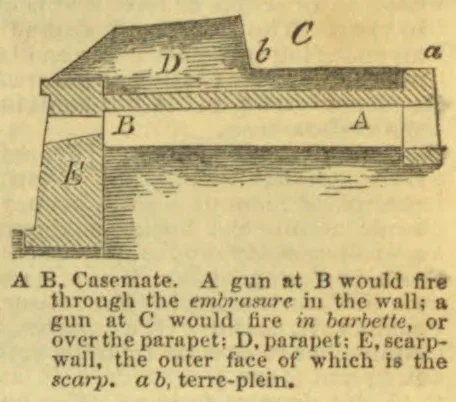
A B, Casemate. A gun at B would fire through the embrasure in the wall; a gun at C would fire in barbette, or over the parapet; D, parapet; E, scarp, the outer face of which is the scarp. a b, terre-plein.
Sense 1. (Fort.) A bomb-proof chamber, usually of masonry, in which cannon may be placed, to be fired through embrasures; or capable of being used as a magazine, or for quartering troops.
Sense 2. (Arch.) A hollow molding, principally used in cornices; a cavetto.