Cen'ter or Cen'tre1, n.
n. [Fr. & Pr. centre, Sp., Pg., & It. centro, Lat. centrum, from Gr. κέντρον, any sharp point, the point round which a circle is described, from κεντεῖν, to prick, to goad.]
Sense 1. A point equally distant from the extremities of a line, figure, or body; the middle point or place of any thing.
Sense 2. The middle or central portion of any thing; the midst.
Sense 3. A point of concentration; the nucleus around which things are gathered; as, a center of attraction.
Sense 4. (Arch.) A temporary framing on which vaulted work is constructed; centering. Gwilt.
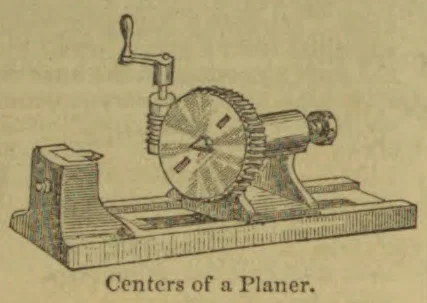
Center of an army, the body of troops occupying the place in the line between the wings.—Centers of a planer, a piece of mechanism fixed temporarily to the table, to hold work between two pins or centers, so that it may be turned round on its axis.—
Center of a fleet, the division between the van and rear of the line of battle, and between the weather division and lee, in the order of sailing.
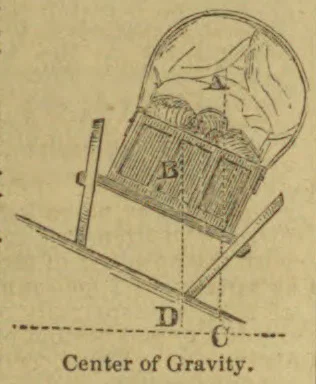
—Center of gravity (Math.), that point of a body about which all its parts are balanced, or which being supported, the whole body will remain at rest, though acted upon by gravity; as, in the illustration, if the center of gravity is at B, the line of gravity, B D, falls within the wheels, and the center of gravity is supported, and will remain at rest; but if the center of gravity is at A, the line of gravity falls without, and the load will be overturned.—Center of gyration (Mech.), that point in a body rotating round an axis, at which, if a given force were applied, it would produce the same angular velocity in a given time as it would if the whole mass of the body were collected at that point.—Center of a lathe (Mech.), either of the two conically-pointed steel pins which pierce the two ends of the body to be turned, and about which it revolves.—Center of motion, the point which remains at rest, while all the other parts of a body move round it.—Center of oscillation, the point in which, if the whole matter of a suspended body were collected, the time of oscillation would be the same as it is in the actual form and state of the body.—Center of percussion, that point in a body moving about a fixed axis at which it may strike an obstacle without communicating a shock to the axis.—Center of pressure (Hydros.), that point in a surface pressed by a fluid, at which, if a force equal to the whole pressure and in the same line be applied in a contrary direction, it will balance or counteract the whole pressure of the fluid. If the side of the vessel be a parallelogram, it is at a point one third of the height of the surface from the bottom.