Cŏl'umn, n.
(kŏl'um), n. [Lat. columna, columen, from cellere, Gr. κέλλειν, to urge, to extend upward; W. colof, stem, stalk, properly colofn and colon, column; Ir. colbh, stalk, stem, column; Pr. & It. colonna, Sp. & Pg. coluna, columna, Fr. colonne.]
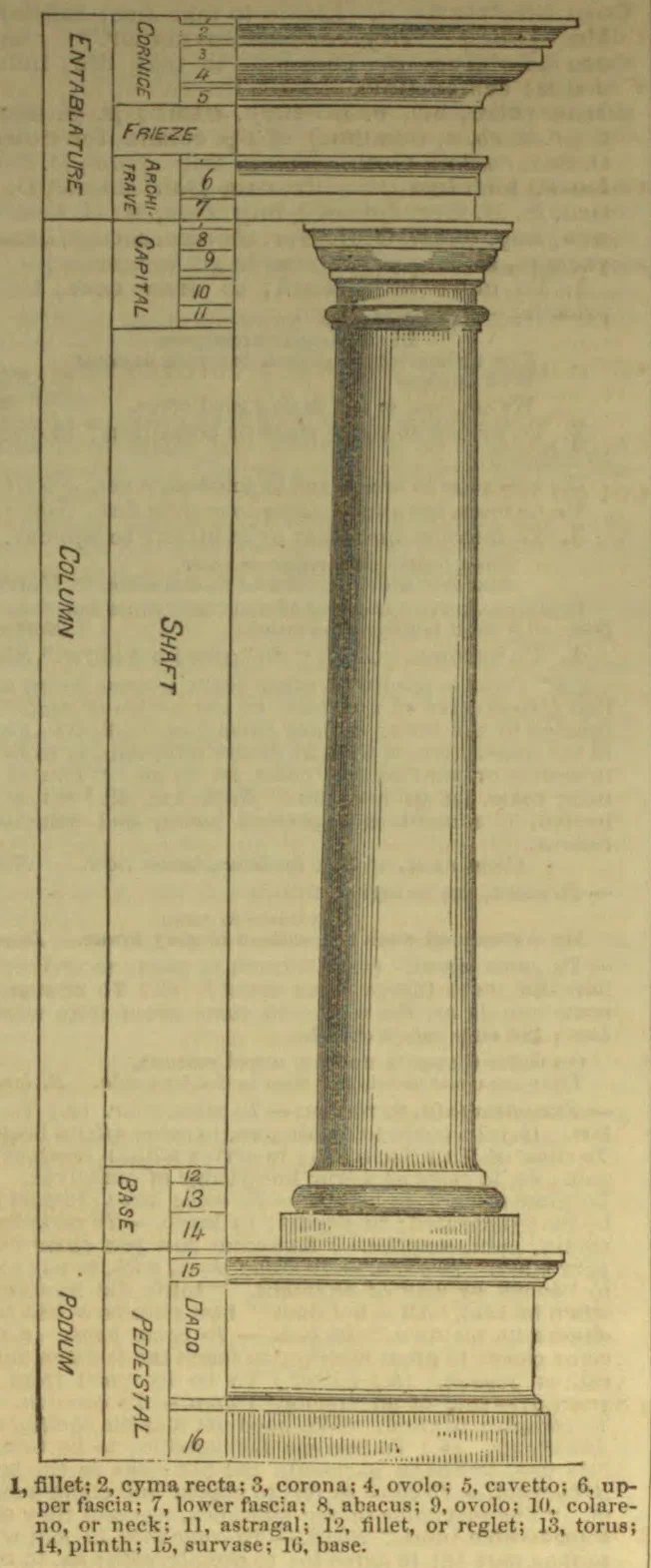
1, fillet; 2, cyma recta; 3, corona; 4, ovolo; 5, cavetto; 6, upper fascia; 7, lower fascia; 8, abacus; 9, ovolo; 10, colare-no, or neck; 11, astragal; 12, fillet, or reglet; 13, torus; 14, plinth; 15, surbase; 16, base.
Sense 1. (Arch.) A cylindrical support for a roof, ceiling, statue, &c.; somewhat ornamented, and composed of base, shaft, and capital; a pillar.
Sense 2. Any upright cylindrical body or structure, considered as resembling, in form or position, a column in architecture; as, a column of air, of water, of mercury, &c.; the column of Trajan; a triumphal column.
Sense 3. (Mil.) A body of troops drawn up in files with a narrow front.
While the besieged . . . suffered comparatively little, the attacking column was thrown into disorder. Prescott.
Sense 4. (Naut.) A body of ships arranged in a line so as to follow in succession.
Sense 5. (Print.) A perpendicular set of lines separated from other matter by a line or blank space; as, a column of figures, of printed matter, &c.
Sense 6. (Bot.) The upright cylindrical body formed by the union of the stamens, or of the stamens and pistils, of a plant, as in the mallow, or the orchis.
Gray.