4 entries under this word

Compound

Com-pound′, v. t.

verbtransitive

v. t. [imp. & p. p. COMPOUNDED; p. pr. & vb. n. COMPOUNDING.] [Lat. componere, from com and ponere, to put, set, Pr. compondre, componere, Catalan compòndrer, Sp. componer, Pg. compor, It. componere, comporre. Cf. Fr. & Pr. pondre, Catalan póndrer, to lay eggs, from Lat. ponere, to lay. Perhaps originally from COM-POUND, a., q. v.] 1. To put together as elements, ingredients, or parts to form a whole; to combine or unite. Nature does . . . mingle together such bodies as are already compounded of elementary or rather of simple ones. Boyle. 2. To compose; to constitute. [Obs.] His pomp and all what state compounds. Shak. 3. To settle amicably; to adjust by agreement; to discharge from obligation upon different terms from those which were stipulated; as, to compound a debt. I pray, my lords, let me compound this strife. Shak. To compound a felony, to accept of a consideration for forbearing to prosecute.
Com-pound′, v. i.

verbintransitive

v. i. To come to terms of agree-ment; to settle by compromise; to agree; — usually followed by for or with.

Here's a fellow will help you to-morrow; compound with him by the year. Shak.

They were at last glad to compound for his bare commitment to the Tower. Clarendon.

Cornwall compounded to furnish ten oxen after Michaelmas for thirty pounds. Carew.

Cŏm′pound, a.

adjective

a. [O. Eng. compounded, p. p. of compoune, compone, from Lat. componere. See COMPONE, COMPOSE, and supra.] Composed of elements, ingredients, or parts; as, a compound word.

Compound substances are made up of two or more simple substances. Watts.

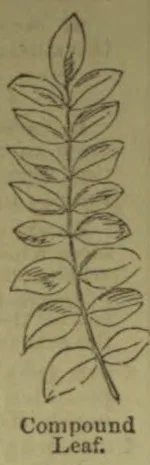
Compound crystal (Crystallog.), a twin crystal, or one seeming to be made up of two or more crystals combined according to regular laws of composition; as, the star-shaped crystals of snow. Dana.—Compound flower, one composed of several florets inclosed in a common perianth, with the anthers connected in a cylinder, as the sunflower or dandelion.—Compound interest. See INTEREST.—Compound larceny (Law), that which is accompanied with the aggravation of taking goods from one's building or person.—Compound leaf (Bot.), one in which several leaflets are connected in one petiole.—Compound microscope, a microscope made of a combination of lenses arranged in a tube, with usually a stand, stage, and other contrivances for adjustment and convenient use.—Compound motion, that which is the result of two or more forces acting in different but not in opposite directions.—Compound number, one constructed according to a varying scale of denomination; as, 3 cwt., 1 qr., 5 lb.;—called also a denominate number.—Compound quantity (Alg.), a quantity composed of two or more simple quantities or terms, connected by the sign + (plus), or — (minus). Thus, a + b — c, and b² — b, are compound quantities.—Compound ratio, the product of two or more ratios; thus, <i>cd</i>/<i>ab</i> is a ratio compounded of the simple ratios <i>c</i>/<i>a</i> and <i>d</i>/<i>b</i>.—Compound time (Mus.), two or more measures of triple time joined into one.

A botanical drawing of a compound leaf with paired leaflets arranged along a central stem.
Compound Leaf.

Cŏm'pound, n.

noun

n. 1. That which is compounded or formed by the union or mixture of elements, ingredients, or parts; the result of composition. “These most poisonous compounds.” Shak. 2. [A corruption of the Portuguese word campanía.] In the East Indies, a yard round a building.