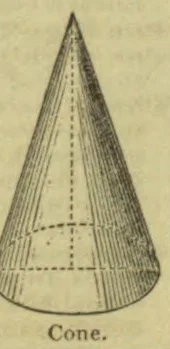
Cōne1, n.
n. [Fr. cone, It. & Sp. cono, Lat. conus, Gr. κῶνος, from Skr. çu, to bring to a point.]
- A solid body generated by the revolution of a triangle about one of its sides, having a circle for its base, and its top terminated in a point or vertex.
- (Bot.) The conical fruit of several evergreen trees, as of the pine, fir, cedar, and cypress. It is composed of woody scales, each one of which has a seed at its base.
- (Conch.) A shell of the genus Conus, having a conical form.
Cone of rays (Opt.), the pencil of rays of light which proceed from a radiant point to a given surface, as that of a lens. — Oblique or scalene cone, a cone of which the axis is inclined to the plane of its base, and its sides unequal. — Right cone, a cone of which the axis is perpendicular to the plane of its base, and its sides equal.