3 entries under this word

Conjugate

Cŏn'ju-gāte, v. t.

verbtransitive

v. t. [imp. & p. p. CONJUGATED; p. pr. & vb. n. CONJUGATING.] [Lat. conjugatus, p. p. of conjugare, from con and jugare, to join, yoke, marry, from jugum, yoke, from jungere, to join.]

Sense 1. To unite in marriage; to join. [Obs.] Wotton.

Sense 2. (Gram.) To distribute the parts or inflections into the several voices, modes, tenses, numbers, and persons.
Cŏn'ju-gate, n.

noun

n. [Lat. conjugatum.] 1. A word agreeing in derivation with another word, and therefore generally resembling it in signification. We have learned, in logic, that conjugates are sometimes in name only, and not in deed. Bramhall. 2. (Chem.) A subordinate radical associated with another, and acting with it the part of a single radical. J. A. Porter.

Cŏn'ju-gate, a.

adjective

a. [Lat. conjugatus, p. p. of conjugare.]

Sense 1. United in pairs; yoked together.

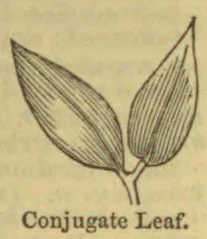
Sense 2. (Bot.) Being in single pairs; coupled. Gray.

Sense 3. (Chem.) Containing two or more radicals acting the part of a single one.

Sense 4. (Gram.) Agreeing in derivation;—said of words.

Conjugate diameter (Geom.), a diameter parallel to a tangent at the vertex of the primitive diameter.

A botanical illustration of two elongated leaves joined at a shared stem.
Conjugate Leaf.