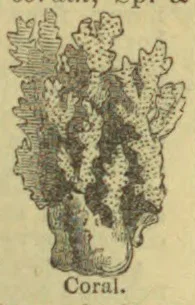
Cōr'al, n.
n. [Lat. corallum, corallium, Gr. κοράλλιον, Fr. corail, Pr. coralh, Sp. & Pg. coral, It. corallo, Ger. koralle.]
Sense 1. The solid secretion of zoophytes, produced within the tissues of the polyps, and corresponding to the skeleton in higher animals. It consists almost purely of carbonate of lime.
Sense 2. A piece of coral, used by children as a plaything.
Her infant grandame's coral next it grew; The bells she jingled and the whistle blew. Pope.
☞ Corals have often the form of trees, shrubs, or hemispheres. Such are madrepores, astreas, and brain-coral. The surface is usually covered with radiated cells, each of which marks the position of one of the polyps; and, when alive, the animals appear like flowers over every part of the zoophyte. The red coral of the Mediterranean used for beads and other purposes is the species Corallium nobile. It is obtained at considerable depths on the coasts of Sicily and Southern Italy, and differs from ordinary white coral in being perfectly compact in texture. Dana.