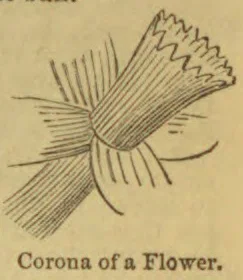
Co-rō'nā, n.
n.; pl. CO-RŌ'NÆ. [Lat. corōna, crown, Gr. κορώνη, any thing curved, κυρωνός, curved.]
- (Arch.) A large, flat member of a cornice, usually of considerable projection, to carry off the rain that falls on it, called by workmen the drip. Gwilt. [See Illustr. of Column.]
- (Anat.) The upper surface of some part, as of a tooth.
- (Astron.) A peculiar luminous appearance, or aureola, which surrounds the dark body of the moon during a total eclipse of the sun.
- (Bot.) (a.) A crown-like margin of the top of a flower. (b.) An appendage at the top of some petals, or seeds.
- (Meteorol.) (a.) A circle, usually colored, around a luminous body, as the sun or moon. (b.) A peculiar phase of the aurora borealis, formed by the concentration or convergence of luminous beams around the point in the heavens indicated by the direction of the dipping needle.
- A crown or circlet suspended from the roof or vaulting of churches, to hold tapers lighted on solemn occasions. It is sometimes formed of double or triple circlets, arranged pyramidically. Fairholt.
- (Mus.) A character called the pause or hold, 𝄐. [Rare.]