5 entries under this word

Cross

Crŏss, n.

noun

(21), n. [O. Fr. crois, croiz, crouiz, cruiz, cruz, crux, now croix, from Lat. crux, crucis, a cross; Pr. crotz, cros, Sp. & Pg. cruz, It. croce.]

Sense 1. A gibbet, consisting of two pieces of timber placed transversely upon one another, in various forms, as a T, or †, with the horizontal piece below the upper end of the upright, or as an X. It was anciently used in the execution of criminals.

Nailed to the cross by his own nation. Milton.

Sense 2. The theological and religious import of the death of Christ; the Christian doctrine; the gospel. “’Tis where the cross is preached.” Cowper.

Sense 3. The symbol of Christ’s death; the ensign and chosen symbol of Christianity; hence, the Christian religion, and also those who receive that religion; Christian nations; Christendom.

Crosses.

Sense 1. Latin cross; cross of Jesus and the evangelists; in the church of Rome, carried before bishops.

Sense 2. Double cross; carried before cardinals and archbishops; (Her.) the patriarchal cross.

Sense 3. Triple cross; carried only before the pope.

Sense 4. St. Andrew’s and St. Patrick’s cross; (Her.) saltire.

Sense 5. Maltese cross.

Sense 6. Egyptian cross.

Sense 7. Cross of Jerusalem; (Her.) cross potent.

Sense 8. (Her.) A cross pattee or formée.

Sense 9. (Her.) A cross patonce.

Sense 10. Greek cross, with crosslets.

Sense 11. Greek cross, counter-changed.

In glorious Christian field Streaming the ensign of the Christian cross Against black pagans, Turks, and Saracens. Shak.

Before the cross has waned the crescent’s ray. W. Scott.

Sense 4. A piece of money stamped with the figure of a cross; also, that side of such a piece on which the cross is stamped; hence, money in general.

I should bear no cross if I did bear you; for I think you have no money in your purse. Shak.

Thy crosses be on gates all, in thy purse none. Heywood.

Sense 5. Affliction regarded as a test of patience or virtue; trial; vexation; disappointment; opposition.

Heaven prepares a good man with crosses. B. Jonson.

Sense 6. (Arch.) An ornament in the form of a cross, used especially on buildings devoted to religious worship; also, a monument in the form of a cross, or surmounted by a cross, set up in public places; as Charing-cross in London.

Dun-Edin’s Cross, a pillared stone, Rose on a turret octagon. W. Scott.

Sense 7. A heraldic device or ornament.

Sense 8. The cross-like mark or symbol used instead of a signature by those who are unable to write.

Sense 9. Church lands. [Ireland.] Davies.

Sense 10. A mixing of breeds or stock, especially in cattle-breeding; or the product of such intermixture.

Sense 11. (Surveying.) An instrument for laying off offsets from the main course, and perpendicular to it.
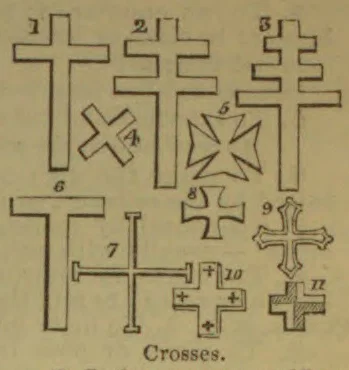
An illustration of eleven different styles of crosses, numbered in order.
Crosses.

Crŏss, a.

adjective

a. 1. Not parallel or correspondent in direction; lying or falling athwart; transverse; oblique; intersecting. “The cross refraction of the second prism.” Newton.

Sense 2. Not accordant with what is wished or expected; interrupting; adverse; contrary; perverse; unfortunate. “A cross fortune.” Bp. Taylor.

I can not, without some regret, behold the cross and unlucky issue of my design. Glanville.

The article of the resurrection seems to lie marvelously cross to the common experience of mankind. South.

We are both love’s captives, but with fates so cross, One must be happy by the other’s loss. Dryden.

Sense 3. Characterized by peevishness or fretfulness; ill humored. “Because he had received a cross answer from his mistress.” Bp. Taylor.

Sense 4. Made in an opposite direction, or an inverse relation; mutually inverse; interchanged; as, cross interrogatories; cross marriages, as when a brother and sister marry persons standing in the same relation to each other.

Synonyms—Fretful; peevish. See FRETFUL.

Crŏss, prep.

preposition

Athwart; transversely; over; so as to intersect; across. [Obs.]

And cross their limits cut a sloping way. Dryden.

Crŏss, v. t.

verbtransitive

(21), v. t. [imp. & p. p. CROSSED (krŏst); p. pr. & vb. n. CROSSING.]

  1. To put across or athwart; to cause to intersect; as, to cross the arms; to cross swords.
  2. To lay or draw something, as a line, across; as, to cross the letter t.
  3. To pass from one side to the other of; to pass or move over; to traverse.

Pondering his voyage; for no narrow frith He had to cross. Milton. 4. To run counter to; to thwart; to obstruct; to hinder; to clash or interfere with; to contravene. In each thing give him way; cross him in nothing. Shak. Purposes which no false thought shall cross. Wordsworth. 5. To interfere and cut off; to debar. To cross me from the golden time I look for. Shak.

  1. To make the sign of the cross upon;—followed by the reflexive pronoun.
  2. To cancel by marking crosses on or over; to erase;—usually with out, off, or over.
  3. To cause to interbreed;—said of different stocks or races; to mix the breed of.

Crŏss, v. i.

verbintransitive

v. i. 1. To lie or be athwart.

  1. To move or pass from one side toward the other, or from place to place; to make a transit; as, to cross from New York to Liverpool.
  2. To be inconsistent. [Obs.]

Men's actions do not always cross with reason. Sidney. 4. To interbreed, as races; to mix breeds. If two individuals of distinct races cross, a third is invariably produced different from either. Coleridge.