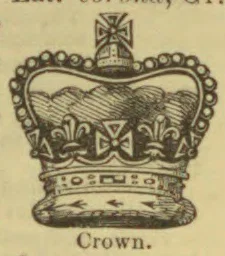
Crown1, n.
n. [O. Eng. corone, coroun, O. Fr. corone, N. Fr. couronne, Pr., Sp., It., & Lat. corona, Gr. κορώνη, Ger. & Dan. krone, Sw. krona, D. kroon.] 1. A wreath or garland, or any ornament encircling the head, especially as a badge of dignity or power; hence, any mark of honorable distinction. “An olive-branch and laurel-crown.” Shak. Hid'st thou that forehead with a golden crown! Shak. What seemed his head The likeness of a kingly crown had on. Milton. Let merit crowns and justice laurels give. Dryden. 2. Any object sought for as a reward, prize, end, or consummation; any thing which imparts beauty, dignity, or finish. They do it to obtain a corruptible crown; but we an incorruptible. 1 Cor. ix. 25. Mutual love, the crown of all our bliss. Milton. 3. The person entitled to wear a regal or imperial crown; the sovereign;—with the definite article. Large arrears of pay were due to the civil and military servants of the crown. Macaulay. 4. The supreme authority in a monarchy; regal power; sovereignty; royalty. Had Philip been capable of comprehending such a mind, the prince [of Orange] . . . would have enabled the monarch to transmit that beautiful cluster of provinces without the loss of a single jewel to the inheritors of his crown. Motley.
- A piece of money stamped with the image of a crown; hence, a certain denomination of coin; as, the English crown, a silver coin of the value of five shillings sterling, or a little more than $1.20.
- The chief or topmost part of any thing; the summit.
From toe to crown he'll fill my skin with pinches. Shak. The steepy crown of the bare mountains. Dryden.
- The part of a hat above the brim; also, the flat circular part at the top of a hat.
- (Arch.) (a.) The highest or topmost member of a cornice; the corona. (b.) The summit of any part of a building; as, the crown of an arch, of a cornice, &c.
- (Bot.) An appendage at the top of the claw of some petals;—called also corona. Gray.
- (Naut.) (a.) That part of an anchor where the arms are joined to the shank. (b.) The bights formed by the several turns of a cable. Totten.
- (Jewelry.) The upper range of cut surfaces in a rose-diamond.
- (Eccl.) A round spot shaved clean on the top of the head, as a mark of ecclesiastical character or distinction; the tonsure.
- (Geom.) The area inclosed between two concentric perimeters.
Pleas of the crown (Law). See PLEAS.