Dī-ăg'o-nal1, a.
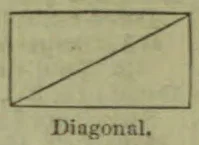
a. [Lat. diagonalis, from Gr. διαγώνιος, from angle to angle, from διά, through, and γωνία, an angle, Fr. diagonal.] (Geom.) Joining two not adjacent angles of a quadrilateral or multilateral figure, and dividing it into two parts; hence, crossing at an angle with one of the sides.
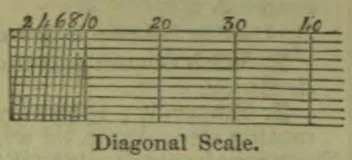
Diagonal scale, a scale which consists of a set of parallel lines, with other lines crossing them obliquely, so that their intersections indicate smaller subdivisions of the unit of measure than could be conveniently marked on a plain scale.