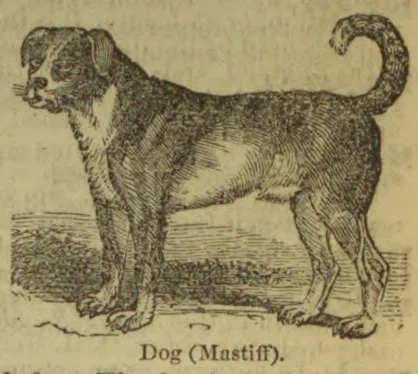
Dŏg1, n.
n. [D. dog, Icel. doggr, Dan. & Sw. dogge, Ger. dogge, docke, Fr. dogue.]
Sense 1. (Zoöl.) A quadruped of the genus Canis (C. familiaris). There are upwards of thirty enumerated varieties, as the mastiff, the hound, the spaniel, the shepherd’s dog, the terrier, the harrier, the bloodhound, &c. The dog is distinguished for intelligence, docility, and attachment to man, above all other of the inferior animals.
Sense 2. A mean, worthless fellow; a wretch.
Sense 3. A fellow;—used humorously; as, a sly dog; a lazy dog. [Colloq.]
Sense 4. (Astron.) One of the two constellations in the southern hemisphere, Canis Major and Canis Minor, or the Greater Dog and the Lesser Dog.
Sense 5. An iron for holding wood in a fire-place; an andiron.
Sense 6. (Mech.) (a.) A grappling iron, with a claw or claws, held by a chain or ropes, for fastening into wood or other heavy articles, for the purpose of raising or moving them. (b.) An iron with fangs for fastening a log in a saw-pit, or on the carriage of a saw-mill. (c.) A piece in machinery acting as a catch or clutch; especially, (d.) the carrier of a lathe, and, (e.) an adjustable stop to change the motion of a machine tool.
To give or throw to the dogs, to throw away, as useless.—To go to the dogs, to be ruined.
☞ Dog is used in composition to denote a male, as a dog-fox, a dog-otter;—also to denote a thing of cheap, mean quality, as dog-Latin, and the like.