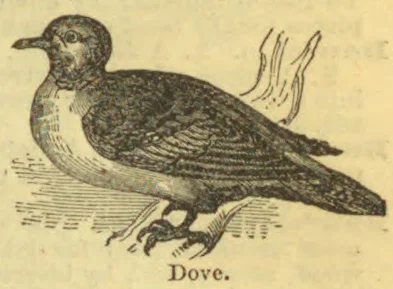
Dōve, n.
n. [A-S. duva, dufe, from dūfan, to dive, O. Sax. dubba, dufa, Goth. dubo, Icel. dufa, Sw. dufva, Dan. due, D. duif, O. D. duyve, O. H. Ger. tuba, duba, N. H. Ger. taube. Cf. Lat. columba, dove, Gr. κόλυμβος, κολυμβίς, diver, a sea-bird, from κολυμβᾶν, to dive.] 1. (Ornith.) A bird of the genus Columba, or pigeon family, some species of which are domesticated, and all of gentle and inoffensive character; a pigeon; especially, a tame pigeon. The common dove, including the varieties called fan-tails, croppers, tumblers; carrier-pigeons, &c., is derived, as is believed, from the rock-pigeon, C. livia; the turtle-dove of Europe, celebrated for its sweet, plaintive note, is the C. turtur; the ring-dove, the largest of European species, is C. palumbus; the Carolina turtle-dove is the Ectopistes Carolinensis. The dove is often employed as the emblem of innocence, gentleness, and affection; also in art and in the Scriptures as the typical emblem or symbol of the Holy Ghost. 2. A word of endearment. “O my dove, let me hear thy voice.” Cant. ii. 14.