E-clipse'1, n.
n. [Fr. éclipse, Lat. eclipsis, Gr. ἔκλειψις, properly a forsaking, failing, from ἐκλείπειν, to leave out, forsake, from ἐκ, out, and λείπειν, to leave.]
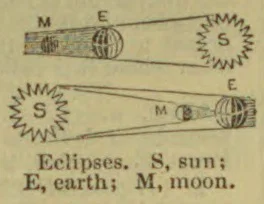
- (Astron.) An interception or obscuration of the light of the sun, moon, or other luminous body, by the intervention of some other body, either between it and the eye, or between the luminous body and that illuminated by it; as of the moon, by passing through the earth's shadow; of the sun, by the moon coming between it and the observer; or of a satellite, by entering the shadow of its primary. The obscuration of a planet or star by the moon or a planet, though of the nature of an eclipse, is called an occultation.
- The loss, usually temporary or partial, of brilliancy, luster, honor, and the like; obscuration.
All the posterity of our first parents suffered a perpetual eclipse of spiritual life. Raleigh.