Es-cāpe'ment, n.
n. [Fr. échappement. See ESCAPE.]
- The act of escaping; escape. [Rare.]
- The contrivance in a time-piece which connects the train of wheel-work with the pendulum or balance, giving to the latter the impulse by which it is kept in vibration;—so called because it allows a tooth to escape from a pallet at each vibration.
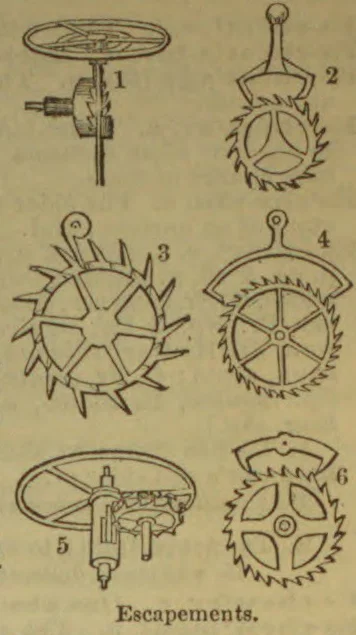
Escapements are of various kinds, as the crown escapement of a common watch (Fig. 1); the anchor escapement of a common clock (Fig. 2); both called recoil escapements, from the recoil of the train at each vibration; the duplex escapement (Fig. 3); the lever escapement (Fig. 4); and the horizontal or cylinder escapement (Fig. 5) of watches; also the dead-beat escapement of astronomical clocks or regulators (Fig. 6), and the detached escapement, or one in which the vibrations of the balance are detached, or nearly so, from the pressure of the motive power during the greater part of the arc of vibration, as in chronometers.