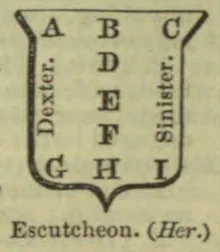
Es-cūtch'eon, n.
(es-kŭch'un), n. [O. Fr. escusson, N. Fr. écusson, from O. Fr. escu, escut, escus, N. Fr. écu, shield, Pr. escut, Sp. & Pg. escudo, It. scudo, Lat. scutum.] 1. (Her.) The shield; the field or ground on which a coat of arms is represented; also, the shield of a family; the token of one's birth and rank. The duke's private band ... displaying on their breasts broad silver escutcheons, on which were emblazoned the arms of the Guzmans. Prescott. The two sides of an escutcheon are respectively designated as dexter and sinister, as in the cut, and the different parts or points by the following names: A, dexter chief point; B, middle chief point; C, sinister chief point; D, honor or collar point; E, fesse or heart point; F, nombril or navel point; G, dexter base point; H, middle base point; I, sinister base point. Escutcheon of pretense, the small shield in the center of his own, on which a man carries the coat of his wife, if she is an heiress, and he has issue by her. Eng. Cyc.
- (Naut.) That part of a vessel's stern on which her name is written. Dana.
- (Carp.) A thin metal plate which guards or finishes the key-hole of a door. Fairholt.