Ev'o-lūte, n.
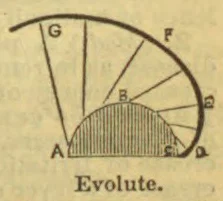
n. [It. evoluta, from Lat. evolutus, p. p. of evolvere, to roll out or forth, to unroll, unfold, from e, out, and volvere, to roll, turn round.] (Geom.) A curve from which another curve, called the involute or evolvent, is described by the end of a thread gradually wound upon the former, or unwound from it; thus, the semicircle A B C is the evolute, and D E F G involute. It is the locus of the centers of all the circles which are osculatory to the given curve or evolvent.
☞ Any curve may be an evolute, the term being applied to it only in its relation to the involute.