Eye1, n.
(ī), n. [A-S. eage, O. Fries. âge, O. Sax. oga, Goth. augō, Icel. auga, Sw. öga, Dan. öje, D. oog, O. H. Ger. ouga, M. H. Ger. ouge, N. H. Ger. auge, allied to Slav. oko, Lith. akis, Skr. akshi, Gr. ὤψ, ὄσσε, dual ὄσσε, Lat. oculus, diminutive of an hypothetical ocus.]
Sense 1. The organ of sight or vision; in man, quadrupeds, and other vertebrates, it is properly the globe or ball movable in the orbit, but often or usually includes the adjacent parts.
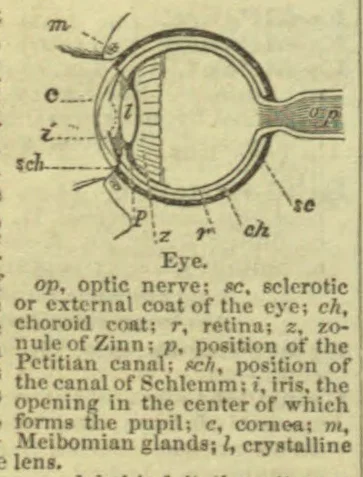
The eye has in front the transparent cornea, and behind this the crystalline lens, for concentrating the rays of light to a focus: posteriorly, in the inner surface of the ball, overlying the black coat, or pigmentum nigrum, of the choroid layer, is the retina, through which the optic nerve is distributed for taking the impression of the image received by the eye through the lens. The outer coat of the ball, which supports the cornea, is called the sclerotic: this is lined with the choroid, with which the iris is connected. In front of the lens is the aqueous humor, and behind it the vitreous humor. In insects, crabs, and other invertebrates, the eyes are generally compound, consisting of an aggregation of minute eyes, with a single cornea over the whole, but having this cornea divided into cornéules for each eye.
Eye.
op, optic nerve; sc, sclerotic or external coat of the eye; ch, choroid coat; r, retina; z, zonule of Zinn; p, position of the Petitian canal; sch, position of the canal of Schlemm; i, iris, the opening in the center of which forms the pupil; c, cornea; m, Meibomian glands; l, crystalline lens.
Sense 2. The power of seeing; unusual power, range, or delicacy of vision; hence, unusual judgment or taste in the use of the eye, and in judging of visible objects; as, to have the eye of a sailor; an eye for the beautiful or picturesque.
Sense 3. The action of the organ of sight; sight; view; ocular knowledge; judgment; opinion; estimate. In my eye, she is the sweetest lady that ever I looked on. Shak.
Sense 4. The space occupied or commanded by the organ of sight; hence, face; front; an object directly opposed or confronted; presence.
We shall express our duty in his eye. Shak. Her shall you hear disproved to your eyes. Shak.
Sense 5. Attentive application, as of the mind; use; observation; watch; inspection; notice.
The eye of the master will do more than both his hands. Franklin.
Sense 6. Look; countenance; aspect.
I'll say yon gray is not the morning's eye. Shak.
Sense 7. That which resembles the organ of sight, in form, position, or appearance; as, (a.) The small hole in the end of a needle. (b.) A catch for a hook; as, the hooks and eyes of a dress. (c.) The spots on a feather, as of a peacock. (d.) The bud or sprout of a plant or root; as, the eye of a potato. (e.) The center of a target. (f.) (Naut.) That part of a loop or stay by which it is attached to, or suspended from, any thing. Totten.
Sense 8. That which resembles the organ of sight in relative importance or beauty; as, the sun is the eye of day. “At the very eye of that proverb.” Shak.
Athens, the eye of Greece, mother of arts. Milton.
Sense 9. A small tint of color, probably as much as is just sufficient for the eye to discern. [Obs.]
Red with an eye of blue makes purple. Boyle.
Eye of day, or eye of the morning, the sun; the light of day. “So gently shuts the eye of day.” Mrs. Barbauld.—Eyes of a ship, the forward part. [Collog.] Dana.—To find favor in the eyes, to be graciously received and treated.—To have an eye to, to pay particular attention to. “Have an eye to Cinna.” Shak.—To keep an eye on, to watch.—To see with half an eye, to see easily. Howell.—To set the eyes on, to see; to have a sight of.