3 entries under this word

Foil

Foil, v. t.

verbtransitive

v. t. [imp. & p. p. FOILED; p. pr. & vb. n. FOILING.] [Fr. fouler, to tread or trample under one's feet, to press, oppress, Pr. folar, It. follare, Sp. hollar. Cf. O. Fr. afoler, to wound, bruise, ruin, Pr. afolar, O. Sp. afollar; It. afollare, to crowd or throng together.]

Sense 1. To beat down with the feet; to trample. [Obs.]

Whom he did all to pieces break and foil.

In filthy dirt, and left so in the loathely soil. Spenser.

Sense 2. To render vain or nugatory, as an effort or attempt; to frustrate; to defeat; to baffle; to balk; as, the enemy attempted to pass the river, but was foiled; he foiled his adversaries.

And by a mortal man at length am foiled. Dryden.

Her long locks that foil the painter's power. Byron.

Sense 3. To blunt; to dull. [Obs.]

When light-winged toys

Of feathered Cupid foil, with wanton dullness,

My speculative and active instruments. Shak.
Foil, n.

noun

n. [See supra.] 1. The failure of success when on the point of being secured; defeat; frustration; miscarriage.

Death never won a stake with greater toil, Nor e'er was fate so near a foil. Dryden.

Sense 2. A blunt sword, or one that has a button at the end covered with leather;—used in fencing.

Foil.

Blunt as the fencer's foils, which hit but hurt not. Shak.

Isocrates contended with a foil against Demosthenes with a sword. Milford.

Foil, n.

noun

n. [O. Fr. fueil, fueille, N. Fr. feuillet, feuille, from Lat. folium, pl. folia; Pr. fueilh, folh, fuelha, folha, O. Sp. foja, N. Sp. hoja, Pg. folha, It. foglia.]

  1. A leaf or thin plate of metal; as, tin foil.
  2. A thin leaf of metal, placed under precious stones by jewelers, to increase their brilliancy, or to give them a particular color, since the stone appears to be of the color of the foil; hence, any thing of another color, or of different qualities, which serves to adorn, or set off another thing to advantage.

Hector has a foil to set him off. Broome.

  1. A thin coat of tin, with quicksilver, laid on the back of a looking-glass, to cause reflection.
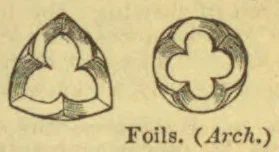
  2. (Arch.) The space between the cusps of featherings in Gothic architecture; a rounded or leaf-like ornament, in windows, niches, &c., called trefoil, quatrefoil, quinquefoil, &c., according to the number of arcs of which it is composed. Oxf. Gloss.
  3. The track or trail of game when pursued.
Two architectural foil patterns are shown: a trefoil and a quatrefoil.
Foils. (Arch.)