3 entries under this word

Forge

Fōrge, n.

noun

n. [Fr. forge, Sp. & Pg. forja, Prov. It. forgia, Pr. farga, Sp. also fragua, from Lat. fabrica, the work-shop of a faber or artisan who works in hard materials, forger, smith.]

Sense 1. A place or establishment where iron or other metals are wrought by heating and hammering; especially, a furnace, or a shop with its furnace, &c., where iron is heated and wrought; a smithy; also, the works where iron is rendered malleable by puddling and shingling; a shingling-mill.

Sense 2. A work-shop; a place where any thing is produced, shaped, or devised.

In the quick forge and working-house of thought. Shak.

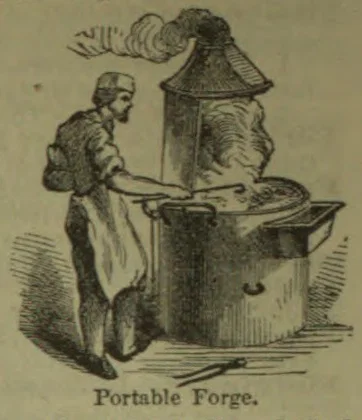
Portable forge, a light and compact blacksmith’s forge, with bellows, &c., that may be moved from place to place;—much used in iron ship-building, boiler-work, &c.

Sense 3. The act of beating or working iron or steel; the manufacture of metallic bodies. [Obs.]

In the greater bodies the forge was easy. Bacon.
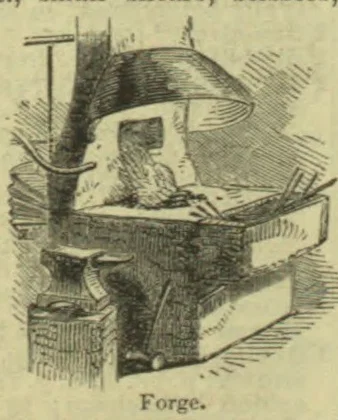
An engraving of a blacksmith’s forge with a fire beneath a hood and an anvil nearby.
Forge.
A person operates a portable forge, pumping its bellows beside a fire in a metal basin.
Portable Forge.

Fōrge, v. t.

verbtransitive

v. t. [imp. & p. p. FORGED; p. pr. & vb. n. FORGING.] [Fr. forger, Sp. & Pg. forjar, Prov. It. forgiare, Pr. fargar, Sp. also fraguar. See supra.]

Sense 1. To form by heating and hammering; to beat into any particular shape, as a metal. “Mars’ armor forged for proof eterne.” Shak.

Sense 2. To form or shape out in any way; to produce; to effect.

Names that the schools forged, and put into the mouths of scholars. Locke.

Do forge a life-long trouble for ourselves. Tennyson.

Sense 3. To make falsely; to produce, as that which is untrue or not genuine; to fabricate; to counterfeit, as a signature, or a signed document.

They forge and vent odious slanders. Barrow.

That paltry story is untrue, And forged to cheat such gulls as you. Hudibras.

Forged certificates of his learning and moral character. Macaulay.

Synonyms—To fabricate; frame; counterfeit; feign; falsify.

Fōrge, v. i.

verbintransitive

v. i. 1. To commit forgery.

Sense 2. (Naut.) To move heavily and slowly, as a ship after the sails are furled; to work one's way, as one ship in outsailing another; — used especially in the phrase to forge ahead. Totten.

And off she [a ship] forged without a shock. De Quincey.