Frie'tion, n.
(frĭk'shun), n. [Lat. frictio, fricare, frictum, to rub; Fr. friction.]
- The act of rubbing the surface of one body against that of another; attrition; abrasion.
- (Mach.) The effect of rubbing, or the resistance which a moving body meets with from the surface on which it moves.
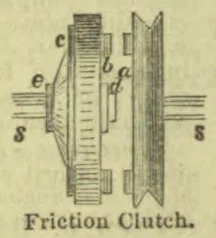
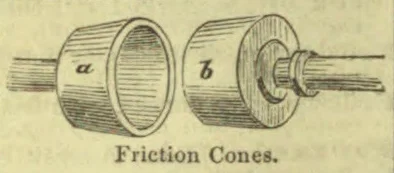
Friction balls, or friction rollers, balls or rollers placed so as to receive the pressure or weight of bodies in motion, and relieve friction, as in a revolving dome, or in moving houses. — Friction clutch (Mach.), a clutch one piece of which, b, is kept from turning easily on its shaft, s, by friction (as of the spring-plate, c, pressing it against the collar, d), so that when it engages its counterpart on another shaft, it may, by yielding at first, permit the resistance to be overcome gradually. — Friction cones, a kind of coupling in which motion is communicated by the friction of the surface of a cone, b, fixed on one shaft, against the inner surface of a similar cone, a, into which it may be thrust, fixed on another shaft. — Friction powder, a composition of chlorate of potash and antimony, which readily ignites by friction. — Friction tube (Mil.), a tube used for firing cannon by means of friction, which generates heat enough to ignite the friction powder, which sets fire to the charge. — Friction wheels (Mach.), a pair of wheels turning freely on their own axes, and sustaining at the angle formed by their circumferences the pivot or journal of a revolving shaft, in order to relieve it of friction.