(gāj), n. 1. A measure; a standard of measure; an instrument to determine dimensions or capacity; a standard of any kind.
A gauge to file your worm and groove to equal breadth by. Moxon.
There is not in our hands any fixed gauge of minds. I. Taylor.
2Sense 2. Measure; dimensions; estimate.
The gauge and dimensions of misery, depression, and contempt. Burke.
3Sense 3. (Mech. & Manuf.) Any instrument for ascertaining or regulating the dimensions or forms of particular things; as, a button-maker’s gauge, a gunsmith’s gauge, and the like.
4Sense 4. (Machine-building.) A template.
5Sense 5. (Physics.) Any instrument or apparatus for measuring the state of a phenomenon, or for ascertaining its numerical elements at any moment;—usually applied to some particular instrument, as a rain-gauge, a steam-gauge, &c.
6Sense 6. (Naut.) (a.) Position with reference to a vessel and to the wind; as, to have the weather-gauge, to be on the windward side of a vessel; to have the lee-gauge, to be on the lee side of a vessel. (b.) The depth to which a vessel sinks in the water. Totten.
7Sense 7. The distance between the rails of a railway. When the gauge is four feet, eight and one half inches, it is called narrow gauge. Wide or broad gauge, in the United States, is six feet; in England, seven feet. There are also other intermediate gauges.
8Sense 8. (Plastering.) (a.) The greater or less quantity of plaster of Paris used with common plaster to accelerate its setting. (b.) The composition made of plaster of Paris and other materials used in finishing plastered ceilings, for moldings, &c.
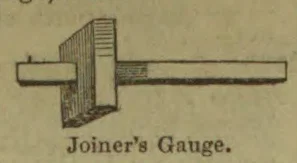
Gauge of a carriage, the distance between the opposite wheels when on the track. — Joiner’s gauge, an instrument used to strike a line parallel to the straight side of a board, &c. — Printer’s gauge, an instrument to regulate the margin of the page. — Rain-gauge, an instrument for measuring the quantity of rain at any given place. — Salt-gauge, an instrument or contrivance for indicating the degree of saltness of water from its specific gravity, as in the boilers of ocean steamers. — Sea-gauge, an instrument for finding the depth of the sea. — Sliding gauge, an instrument used by makers of mathematical instruments for measuring and setting off distances. — Standard gauges, templates and patterns of certain parts and tools common to all machine work. — Steam-gauge, an instrument for measuring the pressure of steam in a boiler. See WATER-GAUGE. — Tide-gauge, an instrument for determining the height of the tides. — Vacuum-gauge, a species of barometer for determining the relative elasticities of the vapor in the condenser of a steam-engine and the air, or for indicating the difference between the vacuum of the condenser and a perfect vacuum. — Water-gauge. (a.) A contrivance for indicating the depth of water, as in a steam-boiler; as, by a gauge-cock or glass;—called also steam-gauge. (b.) The height of the water in the boiler; as, three gauges of water, that is, water up to the third gauge-cock. — Wind-gauge, an instrument for measuring the force of the wind on any given surface; an anemometer.